

Recently, a research group led by Prof. Qin Xiaoying from the Institute of Solid State Physics (ISSP), Hefei Institutes of Physical Science (HFIPS) has made new progress in the thermoelectric performance of Cu3SbSe4. The result abtained from the study proved excellent thermoelectric properties in copper-antimony alloys which were achieved via synergistic regulation of power factors and thermal conductivity.
In this study, AgSb0.98Sn0.02Se2, a kind of nano particles, were introduced into Cu3Sb0.96Sn0.04Se4 matrix, and thus new nanocomposites Cu3Sb0.96Sn0.04Se4 /x wt% AgSb0.98Sn0.02Se2 (x = 0,1,3,5,7) were formed by grinding and electrospark plasma sintering.
The ZT value of Cu3Sb0.96Sn0.04Se4/5wt% AgSb0.98Sn0.02Se2 sample reached a record of 1.17 due to the reduction of thermal conductivity and the enhancement of carrier mobility, which showed good thermoelectric performance.
Thermoelectric materials (TE) enables direct conversion between heat and electricity. Therefore it has been considered as a kind of potentially sustainable energy as it can be used for solid-state refrigerators or heat pumps, replacing moving parts or liquids which are widely used now and harmful to the environment.
Tetrahedrite Cu3SbSe4 has attracted much attention due to its cheap components, low intrinsic lattice thermal conductivity and excellent electrical transport properties. However, there is no effective method to increase the power factor and decrease the thermal conductivity simultaneously. The experiment provides a new strategy for improving performance of thermoelectric materials.
This work is supported by the funding support from the Natural Science Foundation of China.
Link to the paper: Synergetic modulation of power factor and thermal conductivity for Cu3SbSe4-based system
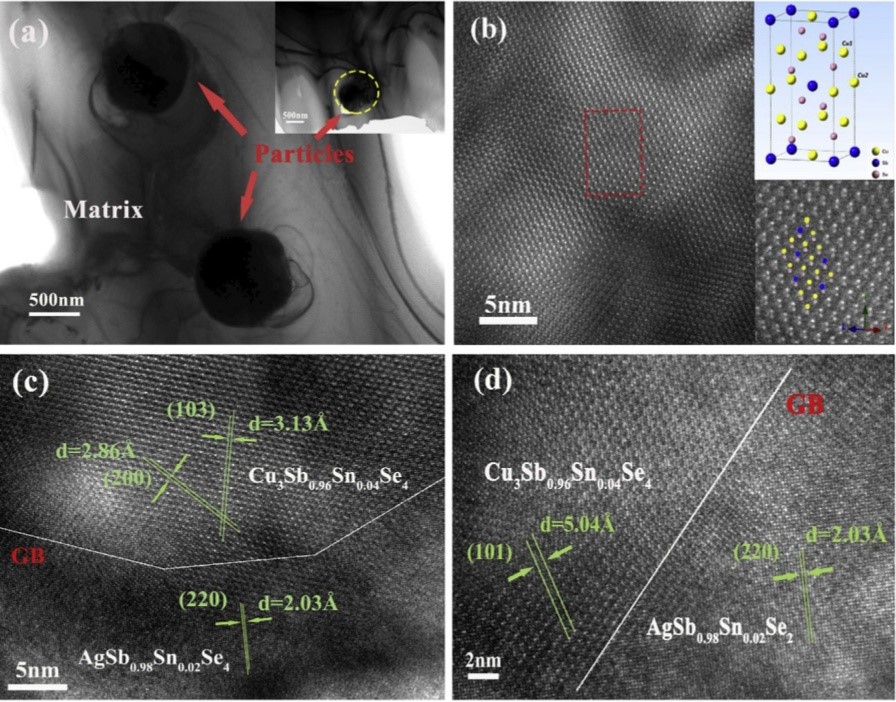
Figure 1. (a) Powder XRD patterns of Cu3Sb0.94Sn0.96Se4-ySy (y = 0.5, 1, and 1.5). (b) Lattice parameter a and c with the sulfur content. (Image by CHEN Tao)
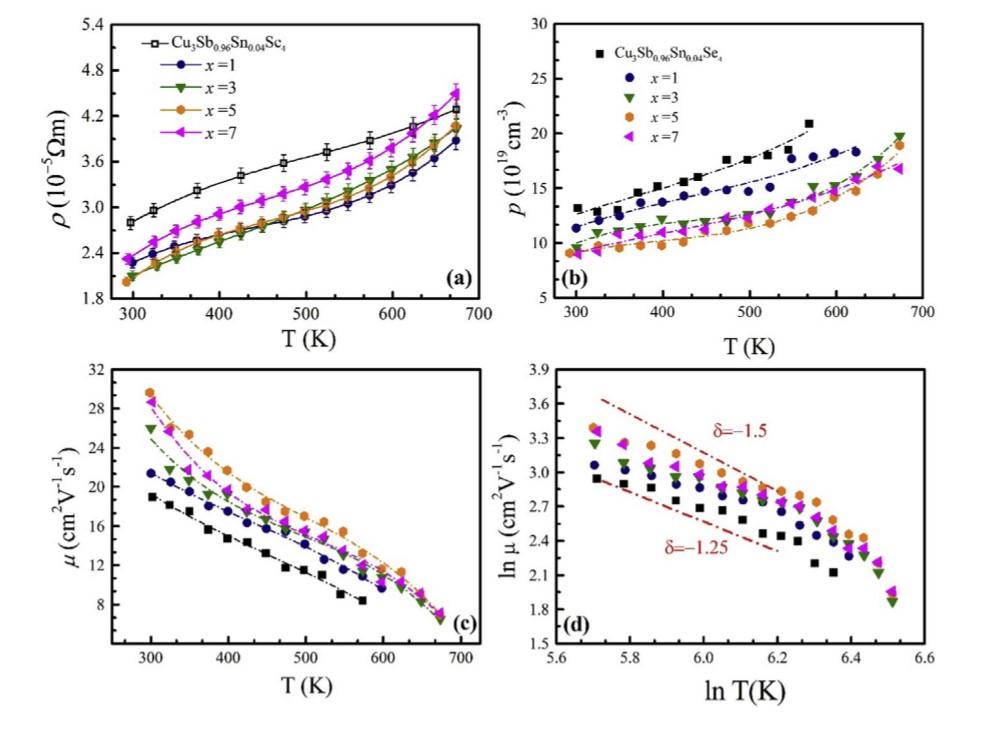
Figure 2. Electrical properties of the pristine Cu3Sb0.96Sn0.04Se4 and Cu3Sb0.96Sn0.04Se4 /x wt% AgSb0.98Sn0.02Se2 (x = 1, 3, 5, 7) composite samples in the temperature range of 300–673 K; (a) electrical resistivity (ρ); (b) carrier concentration (p); (c) carrier mobility; (d) plot of ln carrier mobility with temperature. (Image by CHEN Tao)
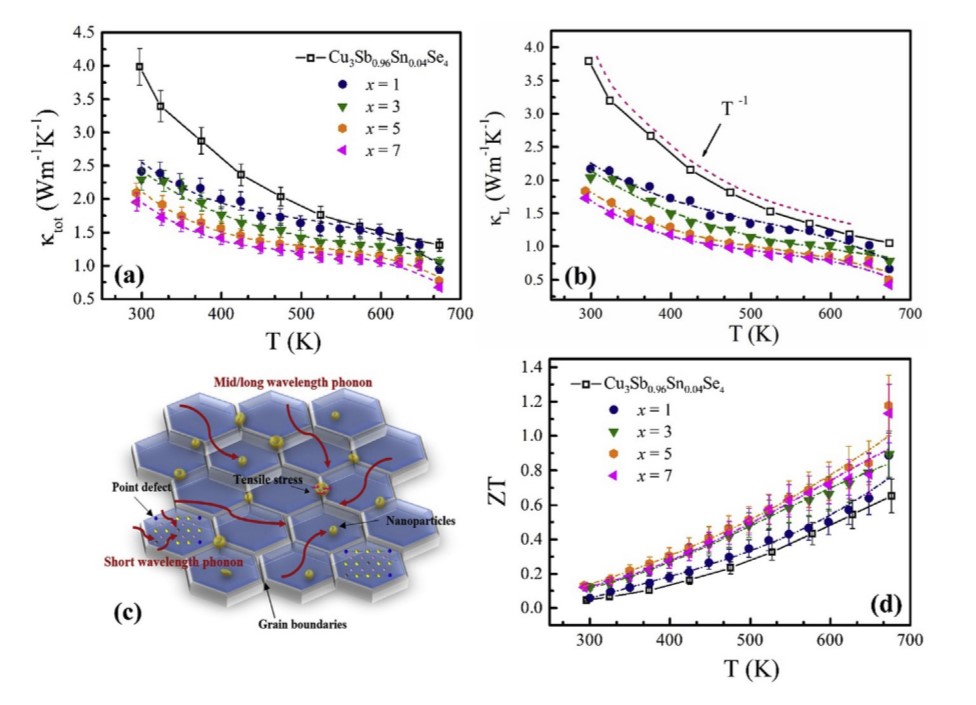
Figure 3. (a–b) Temperature dependence of the total thermal conductivity and lattice thermal conductivity for all samples in this work; (c) schematic drawing of phonon transport process in composites; (d) ZT value of all samples at whole temperature range. (Image by CHEN Tao)
 Tel: +86-551-65591206
 Fax: +86-551-65591270
 Emai: zhous@hfcas.ac.cn
 350 Shushanhu Road