
Glioblastoma multiforme (GBM), also known as glioblastoma and grade IV astrocytoma, is the most common and aggressive brain tumor in adults. GBM displays cellular hierarchies which harbor a subpopulation of stem-like cells (GSCs). The subsets of multipotent cells can grow as spheres and efficiently propagate tumors in xenograft models, reflecting a stem-like, self-renewing and tumor-propagating phenotype. The difficulties in treating glioblastoma may be caused by the presence of GSCs, which are a source of relapse and chemoresistance. Therefore, new therapeutic strategies focusing on impairing GSC maintenance are in urgent need.
A study team led by Prof. FANG Zhiyou in the Center of Medical Physics and Technology (CMPT), Hefei Institutes of Physical Science, identified a role of melatonin in suppressing the self-renewal and tumorigenic activity of GSCs.
Prof. FANG Zhiyou, CHEN Xueran and their coworkers used GSCs that were isolated from surgical specimens from GBM patients to study the role of melatonin as well as to underly its mechanisms in GSC biology.
They found that melatonin directly targeted glioma tumor cells by altering GSC biology and inhibiting GSC proliferation. Additionally, melatonin altered profile of transcription factors to inhibit tumor initiation and propagation. Furthermore, EZH2 S21 phosphorylation and EZH2-STAT3 interaction in GSCs were impaired following melatonin treatment.
These results suggest that melatonin attenuates multiple key signals involved in GSC self-renewal and survival, which, meanwhile further support that melatonin is potentially applicable in GBM therapeutic.
This study entitled Melatonin inhibits tumorigenicity of glioblastoma stem-like cells via the AKT-EZH2-STAT3 signaling axis was published online in Journal of Pineal Research.
The study team expresses thanks to Prof. HAO Aijun for technical assistance in Key Laboratory of the Ministry of Education for Experimental Teratology, Department of Histology and Embryology, Shandong University School of Medicine. And this work was supported by grants from the National Natural Science Foundation of China and Anhui Provincial Nature Science Foundation.
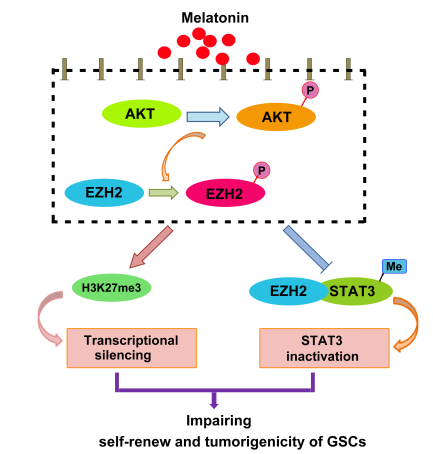
A model of melatonin-inhibited GSC self-renewal and tumor-initiating capacity. Melatonin involved in GSC self-renewal and survival mainly through the following key signals: inhibition of AKT1 activation, impairment of EZH2 S21 phosphorylation and EZH2-STAT3 interactions, and altered histone modifications and transcriptional profile.(Image by CHEN Xueran)
Contact:
FANG Zhiyou
Center of Medical Physics and Technology, Hefei Institutes of Physical Science
Phone: 86-551-62727067
E-mail: z.fang@cmpt.ac.cn
 Tel: +86-551-65591206
 Fax: +86-551-65591270
 Emai: zhous@hfcas.ac.cn
 350 Shushanhu Road