

With the rapid advancement of nanotechnology, there is a development trend towards maintenance-free microelectronic devices such as wireless microsensors, implantable medical devices, nanorobotics, and active radio frequency identification (RFID) tags. Supercapacitors (SCs), also called electrochemical capacitors, is one of the most promising energy storage devices which provide the required power and energy to power up them. However, the large size of conventional SCs and the sandwich electrode configuration make it challenging to integrate conventional SCs with other microelectronic devices mounted on a planar integrated circuit, which greatly limits the miniaturization of the entire microelectronic system. Therefore, design and fabrication of high-performance miniaturized SCs, also called micro-supercapacitors (MSCs), that can be placed directly on a chip and integrated with other microelectronic devices, are essential for developing maintenance-free microelectronic devices.
A study team led by Prof. YE changhui in Institute of Solid State Physics, Hefei Institutes of Physical Sciences, achieves an important progress on enhancing the areal capacitance of MSCs. Their study results were published in Small entitled 3D Interdigital Au/MnO2/Au Stacked Hybrid Electrodes for On-Chip Microsupercapacitors.
In their work, by combining common laser printing technology with electrodeposition technique, a fast, convenient, and scalable strategy was demonstrated to fabricate alternative layer stacked electrodes for high-performance on-chip MSCs. The on-chip electrode configuration can effectively increase the contact area between MnO2 active layer and Au conductive layer as well as result in enhanced pseudocapacitive behavior of MnO2. Based on the Au/MnO2/Au sandwich electrode unit, 3D interdigital stacked electrodes are further constructed which can increase the areal capacitance of the MSCs from 4.3 to 11.9 mF cm-2.
This study shows that enhanced areal capacitance and energy density without increasing the total footprint of the device can be achieved. In addition, flexible and all-solid-state MSCs based on interdigital AMA sandwich hybrid electrodes have also been fabricated by employing PVA/LiClO4 gel electrolyte, which show excellent mechanical flexibility and supercapacitive performance.
Their laser printing technique combined with the physical sputtering and electrodeposition allows the fabrication of MSCs array with random sizes and patterns, making them promising power sources for small-scale flexible microelectronic systems (e.g., next-generation smart phones).
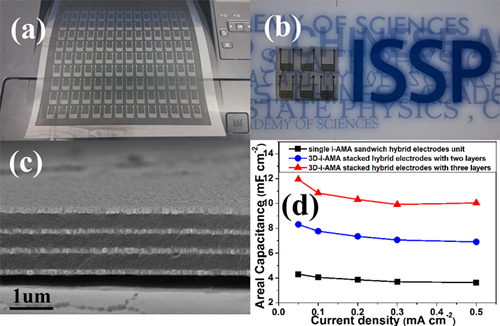
On-chip Micro-supercapacitors with three-dimensional interdigital Au/MnO2 stacked hybrid electrodes exhibit a large areal capacitance of 11.9 mF cm-2. a) a photograph of a large area of printed interdigital patterns on a flexible PET film; b) a photograph of the as-prepared on-chip MSCs with 3D-i-AMA stacked hybrid electrodes; c) a cross-sectional SEM image of 3D-i-AMA stacked hybrid electrodes; d) evolution of the areal capacitance of MSCs based on 3D-i-AMA stacked hybrid electrodes versus current density. (Image by HU Haibo)
Contact:
Prof. YE Changhui
Institute of Solid State Physics (http://english.issp.ac.cn/)
Hefei 230031,China.
Tel: +86-551-65595629
E-mail: chye@issp.ac.cn
 Tel: +86-551-65591206
 Fax: +86-551-65591270
 Emai: zhous@hfcas.ac.cn
 350 Shushanhu Road