

Scientists from the Institute of Solid State Physics, Hefei Institutes of Physical Science developed a new way to enhance ambient ammonia electrosynthesis performance. Their findings were published in Advanced Energy Materials.
Electrocatalytic reduction of N2 to NH3 under ambient conditions has been considered as a promising alternative to the energy and resource intensive Haber–Bosch process.
However, a high yield of NH3 via electrocatalytic NRR is extremely challenge as it requires an electrocatalyst with high catalytic activity to efficiently break the stable triple-bonds of N2 and simultaneously suppress the competitive hydrogen evolution reaction (HER).
It is well known that the 2D-MoS2 is a typical electrocatalyst for HER. 2D-MoS2 also has been reported as an electrocatalyst with NRR properties and can be significantly improved by structural modifications.
However, their studies were mainly focused on the influence of structural and surface defects on NRR catalytic activity rather than suppressing the concurrently occurred HER.
Herein, the team reported the in-operando created strong Li–S interactions to empower the S-rich MoS2 nanosheets with superior NRR catalytic activity and HER suppression functionality. A NH3 yield rate and a faradaic efficiency (FE) in presence of strong Li–S interactions could be achieved more than 8 and 18 times by the same electrocatalyst in the absence of Li–S interactions.
The DFT calculation results also confirmed that the strong Li-S interactions could occur at S-edge sites of MoS2 and such in operando-induced interactions could effectively suppress HER process, enhance N2 adsorption and activate N-N bonds to boost NRR performance.
The reported in-operando formation of catalytic active structures via catalyst– electrolyte interactions opens a new way to design and develop catalysts and catalysis systems.
Link to the paper: Dramatically Enhanced Ambient Ammonia Electrosynthesis Performance by In‐Operando Created Li–S Interactions on MoS2Electrocatalyst
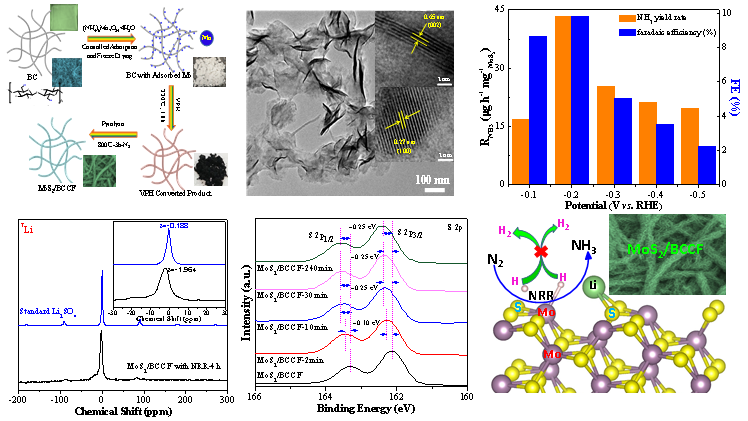
(a) Schematic illustration of the synthesis process of MoS2/BCCF; (b) TEM image of MoS2 nanosheets (insets: HRTEM images of MoS2); (c) NRR performance of MoS2/BCCF in N2-saturated 0.1 M Li2SO4 solution at various potentials; (d) 7Li solid-state NMR spectra of the standard 7Li2SO4 and MoS2/BCCF after NRR in 0.1 M 7Li2SO4 electrolyte; (e) High-resolution S 2p XPS spectra of the as-synthesized MoS2/BCCF and MoS2/BCCF after different NRR time; (f) Schematic illustration the NRR of MoS2/BCCF with Li–S interactions. (Image by LIU Yanyan)
Contact:
ZHOU Shu
Hefei Institutes of Physical Science (http://english.hf.cas.cn/)
Email: zhous@hfcas.ac.cn
 Tel: +86-551-65591206
 Fax: +86-551-65591270
 Emai: zhous@hfcas.ac.cn
 350 Shushanhu Road