

A Chinese research team from High Magnetic Field Laboratory, Chinese Academy of Sciences (CHMFL) developed a novel pan-KIT kinase inhibitor (CHMFL-KIT-64) against Broad-Spectrum Mutants of c-KIT Kinase.
GISTs are the most common mesenchymal tumors of the digestive tract. Imatinib was approved as the first-line treatment for advanced gastrointestinal stromal tumors (GISTs). However, most patients will eventually relapse due to secondary mutations upon chronic treatment.
Although sunitinib and regorafenib as the second-line and third-line therapy for GISTs respectively could overcome some of the drug-resistant mutations, they have limited overall clinical response and exhibit severe side effects.
Therefore, new therapeutics which bear different potency profiles against the broad spectrum of the c-KIT mutants are still in great demand.
Through the type II kinase inhibitor binding element hybrid design approach, the researchers discovered a novel c-KIT kinase inhibitor CHMFL-KIT-64, which is potent against c-KIT wild type (wt) and a broad spectrum of c-KIT primary gain-of-function mutants, secondary mutants and A-loop mutants.
CHMFL-KIT-64 exhibits good anti-proliferative effects against imatinib-sensitive cell line GIST-T1, imatinib-resistant cell lines GIST-5R and GIST-T1-T670I as well as the c-KIT wt patient primary cells which are known to be imatinib-resistant.
CHMFL-KIT-64 also displayed good in vivo pharmacokinetic properties in different species such as mice, rats and dogs.
In addition, CHMFL-KIT-64 exhibits good in vivo anti-tumor efficacy in the c-KIT T670I, D820G and Y823D mutant-mediated preclinical mice models of GISTs.
The study may provide a new potential therapeutic candidate for GISTs.
This work was supported by the National Natural Science Foundation of China and the “Personalized Medicines-Molecular Signature-Based Drug Discovery and Development”, Strategic Priority Research Program of the Chinese Academy of Sciences.
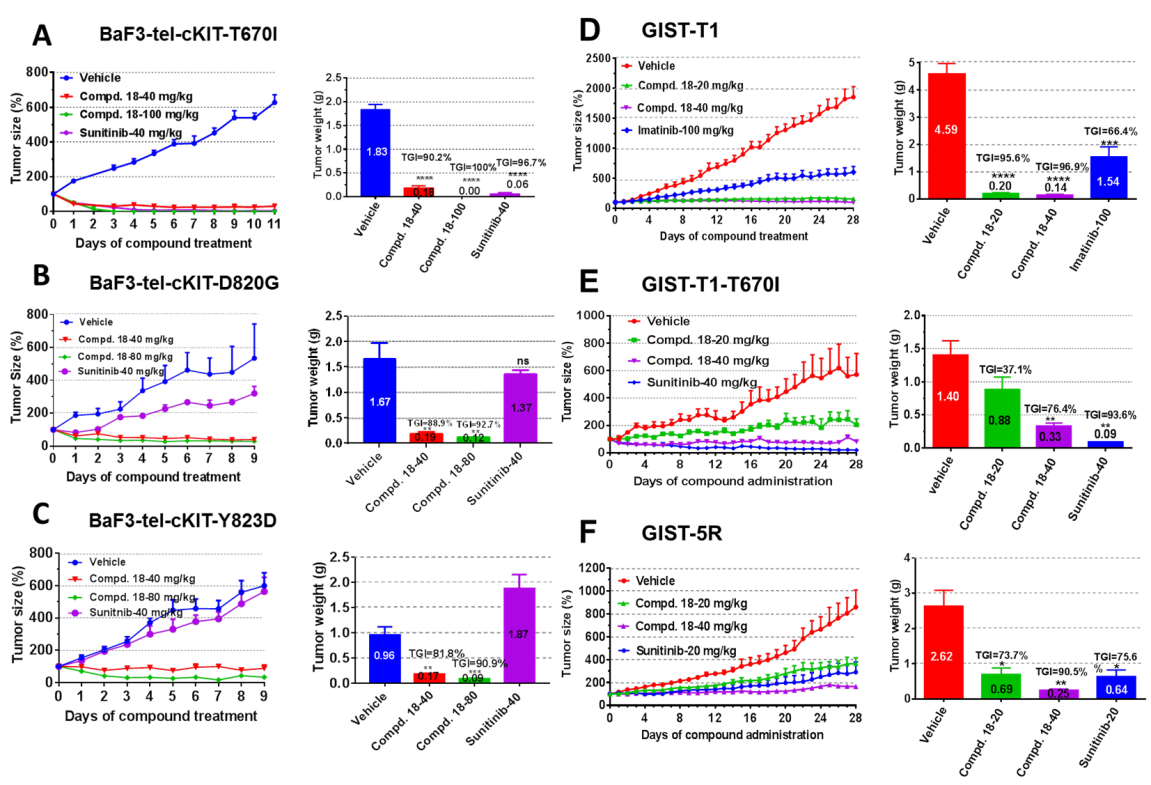
Anti-tumor efficacy of CHMFL-KIT-64 (compd. 18) in the xenograft mouse models (Image by WANG Beilei)
Contact:
ZHOU Shu
Hefei Institutes of Physical Science (http://english.hf.cas.cn/new/)
Email: zhous@hfcas.ac.cn
 Tel: +86-551-65591206
 Fax: +86-551-65591270
 Emai: zhous@hfcas.ac.cn
 350 Shushanhu Road