


Recently, researchers from the Hefei Institutes of Physical Science (HFIPS) of the Chinese Academy of Sciences, together with the British Antarctic Survey and the University of Bremen, systematically investigated the sources of reactive bromine in the Arctic troposphere and their impact on atmospheric oxidative capacity in polar regions.
The study was based on long-term observations from the Chinese Arctic Yellow River Station and simulations using the p-TOMCAT chemical transport model.
The results were published in Atmospheric Chemistry and Physics.
Polar regions are highly sensitive to climate change. Rising temperatures and sea ice loss are changing the environment and affecting atmospheric chemistry. Tropospheric bromine monoxide (BrO) is a key species involved in springtime Arctic ozone depletion. It is thought to originate from sea-ice snowpacks, blowing snow, and sea salt aerosols, but long-term observations are still limited, making its sources and processes not fully clear.
In this study, the team used a multi-axis differential optical absorption spectroscopy (MAX-DOAS) system independently developed by HFIPS and carried out more than ten years of continuous observations at the Yellow River Station. The measurements provided long-term records of tropospheric BrO and aerosol extinction profiles, helping improve the performance of chemical transport models in simulating reactive bromine and ozone. The p-TOMCAT model successfully reproduced Arctic springtime bromine explosion events and ozone depletion episodes, suggesting that reactive bromine sources had previously been underestimated.
The study found that blowing snow over sea ice plays a major role in releasing reactive bromine, while recycling processes on sea salt aerosol surfaces help maintain high BrO levels in the Arctic troposphere. Source analysis further showed that blowing snow over multi-year sea ice contributes more than 50% of the bromine emissions associated with total sea ice, a contribution comparable to that from first-year sea ice.
"These findings show that multi-year sea ice plays a key role in Arctic bromine explosions and give us new insight into how reactive bromine behaves in the Arctic atmosphere," said Prof. LUO Yuhan, a member of the team.
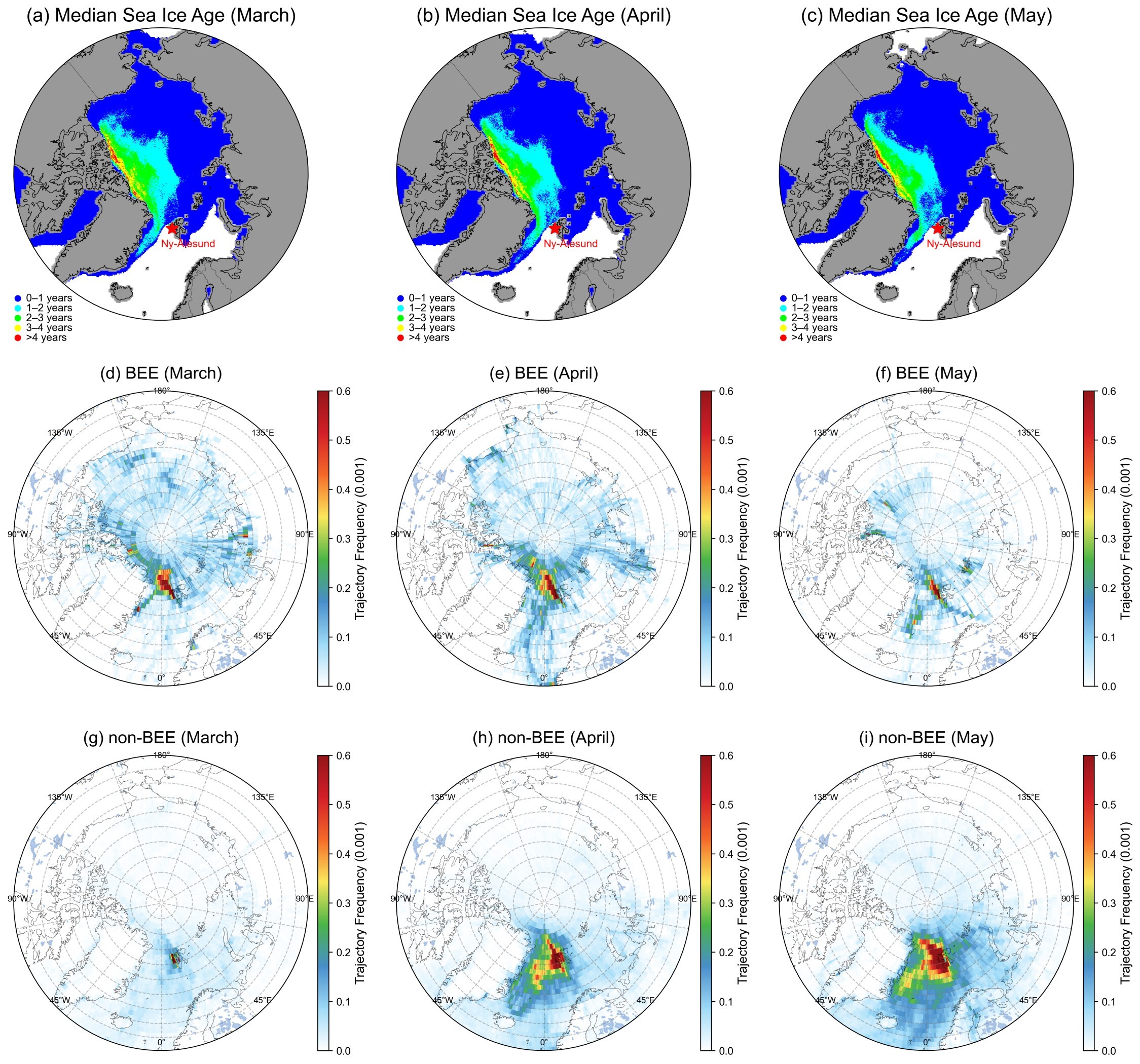
Monthly median sea ice age (a–c) and the frequency of air masses along the 5 d backward trajectories when the air masses are below 500 m during BEEs (d–f) and non-BEEs (g–i) in Ny-Ålesund for March, April, and May during 2017–2023. (Image by LI Qidi)