A research team led by Prof. MENG Guowen and Prof. CHEN Bin from the Institute of Solid State Physics, Hefei Institutes of Physical Science, Chinese Academy of Sciences, has developed a high-entropy antiperovskite electrode (InN(NiCoFeCrV)₃) supported by nickel foam for efficient anion-exchange membrane (AEM) water electrolysis, improving the efficiency and durability of hydrogen production.
The integrated electrode enabled an AEM electrolyzer to operate efficiently at high current densities, demonstrating its potential for large-scale green hydrogen production.
The study was published in ACS Nano.
Water electrolysis uses renewable electricity from sources such as solar and wind power to produce clean hydrogen. Among various technologies, AEM water electrolysis combines the advantages of traditional alkaline systems and proton-exchange membrane systems. However, its large-scale application is still limited by the slow oxygen evolution reaction (OER) and the need for catalysts with high activity and long-term stability.
To address this challenge, the researchers designed a high-entropy antiperovskite electrode containing five metal elements — nickel, cobalt, iron, chromium, and vanadium — grown directly on nickel foam. The unique structure helps maintain catalytic activity while promoting the formation of active sites during operation.
"Our goal was to develop a durable and efficient electrode for large-scale hydrogen production," said Prof. MENG Guowen, "This electrode showed excellent oxygen evolution performance and long-term stability in AEM water electrolysis, demonstrating its potential for practical hydrogen production."
Tests showed that the electrode required an overpotential of only 279 mV to reach a current density of 100 mA cm-2 and remained stable for more than 500 hours in alkaline electrolyte. When used in an AEM electrolyzer, it delivered 500 mA cm-2 at a cell voltage of 1.662 V and maintained stable operation for over 400 hours with little performance loss.
Further analysis showed that some metal elements gradually dissolved during operation, leading to the formation of an active surface layer. The interaction between the surface layer and the underlying material improved charge transfer and enhanced catalytic performance.
The study provides a new strategy for designing durable, low-cost electrodes for AEM water electrolysis and supports the development of more efficient green hydrogen technologies.
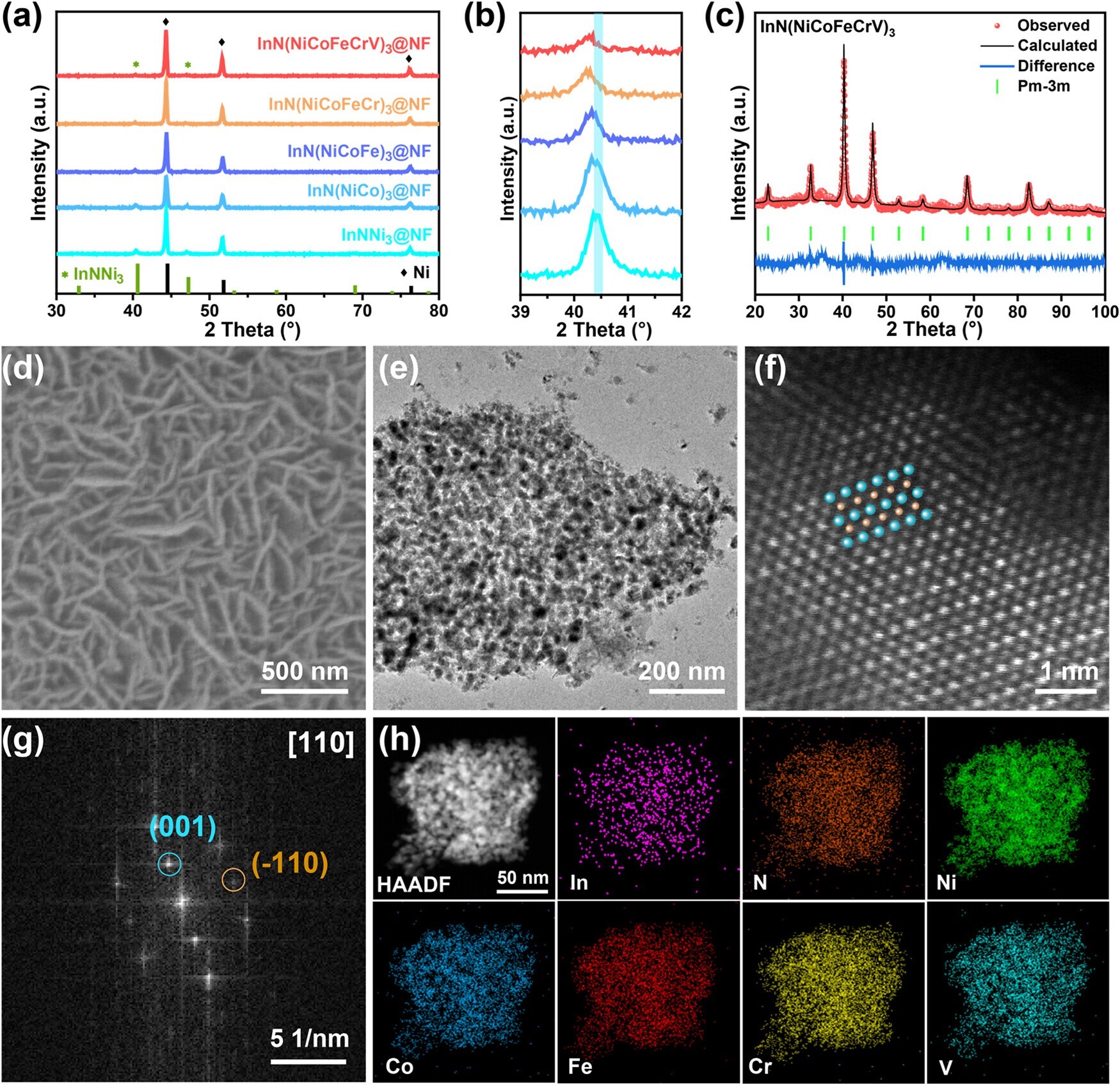
Structural and morphological characterization of the InN(NiCoFeCrV)₃@NF integrated electrode (Image by Chenbin)