



A research team led by Prof. ZHIGAO Sheng at the High Magnetic Field Laboratory, Hefei Institutes of Physical Science, Chinese Academy of Sciences, has found that changing the magnetic dimensionality of a layered material can significantly speed up its spin dynamics. By adjusting the number of chromium vacancies in Cr2₋δTe2, the researchers increased the spin-wave frequency by more than five times.
The research was published in Newton, a journal by Cell Press.
Magnons are waves of coordinated spin motion in magnetic materials. They can carry information without moving electric charge, making them promising for future information technologies that could use less energy than conventional electronics. The speed, stability, and travel distance of these waves are all important for their potential applications.
In this research, the researchers studied two Cr2₋δTe2 crystals with different concentrations of chromium vacancies. Using ultrafast spectroscopy measurements, they tracked how the spins precession to changes in magnetic dimensionality.
They found that increasing the chromium vacancy concentration changed the material's magnetic behavior from quasi-three-dimensional to quasi-two-dimensional. Along with this change, the spin-wave frequency rose from 37 to 194 GHz under a magnetic field of 1 tesla. At 7 tesla, it reached 352 GHz.
The faster spin dynamics, however, came with stronger damping, meaning that the spin waves lost energy more quickly. The researchers found that stronger magnetic anisotropy was mainly responsible for the higher frequency, while scattering caused by chromium vacancies contributed to the increased damping. Weaker magnetic coupling between layers also restricted spin-wave propagation between layers, making the spin dynamics more localized.
"By changing the magnetic dimensionality, we can control not only the frequency of spin waves but also how quickly they lose energy and how they propagate," said Prof. SHENG. "This understanding could help guide the design of high-frequency devices based on layered magnetic materials."
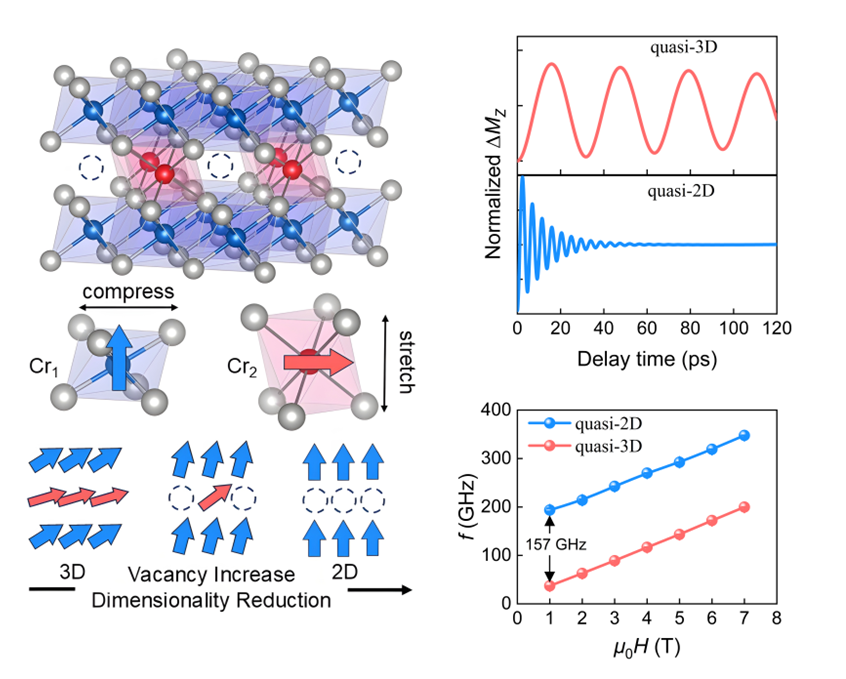
Cr2-δTe2 provides an ideal platform toreveal how magnetic dimensionality governs ultrafast spin dynamics. Reducing dimensionality strongly increases spin-wave frequency and damping. (Image by REN Yifan)

