


Recently, a research team led by Prof. LIU Haiqing from the Hefei Institutes of Physical Science of the Chinese Academy of Sciences, in collaboration with Prof. CAI Huishan' s group from University of Science and Technology of China, for the first time, systematically revealed the physical mechanism through which the plasma current profile, magnetohydrodynamic (MHD) instabilities, and toroidal rotation mutually couple and spontaneously evolve via a self-organization process.
The findings have been published in Nuclear Fusion.
One major challenge in realizing fusion energy is keeping high-performance plasma stable for very long periods. This requires not only precise external control but also the plasma’s own ability to form self-organized steady states. However, the way key plasma parameters interact and evolve during this process is still not fully understood.
In this study, researchers examine a representative long-pulse discharge on EAST. Early in the discharge, a tearing mode appeared and lasted for an extended period. Even though the external heating power stayed constant, the current profile slowly evolved on its own through nonlinear interactions between the lower-hybrid current drive and the plasma’s poloidal magnetic field. This strengthened the magnetic shear and eventually suppressed the tearing mode. After the mode disappeared, the core electron temperature rose and the overall confinement improved.
At the same time, the team observed an interesting transition between two types of modes: a long-lived mode alternating with a high-frequency mode. The analysis shows that when the electron temperature gradient becomes sufficiently strong, the high-frequency mode is triggered. Its frequency shows a characteristic chirping pattern linked to the temperature gradient, similar to drift-tearing behavior, and may help sustain the electron-temperature internal transport barrier.
Experiments and simulations further revealed that these MHD activities generate toroidal torque through the neoclassical toroidal viscosity effect. The tearing mode produces a braking torque opposite to the plasma’s natural rotation, and once it disappears, this torque weakens, allowing the core rotation to accelerate—likely contributing to the improved confinement.
This research shows that during long-pulse discharges, the plasma can naturally move from a less stable state to a more stable, higher-performance one through self-organization, helping clarify how steady long-pulse operation is maintained.
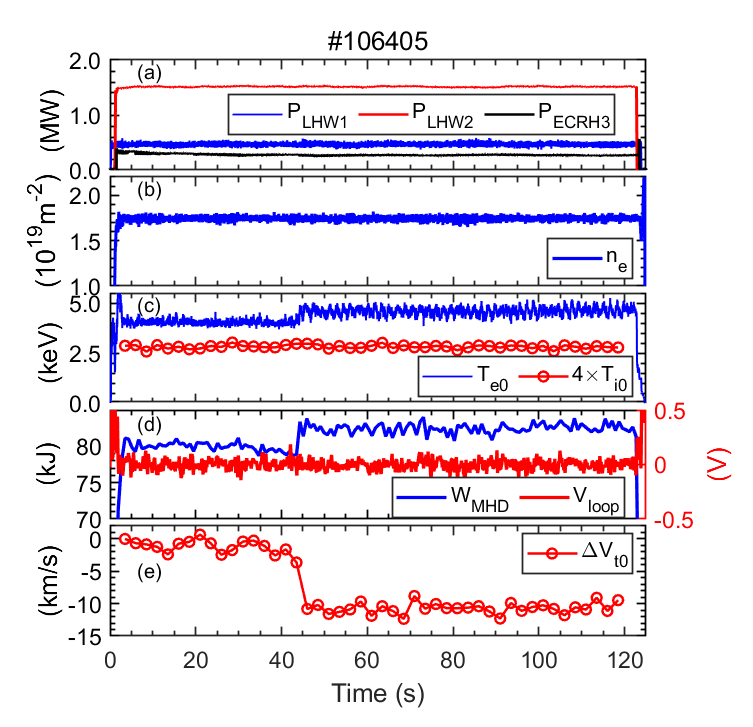
Plasma parameters in the discharge (Image by ZHU Rongjie)