



Recently, the research team led by Prof. LI Yonggang and Prof. ZENG Zhi from the Institute of Solid State Physics, the Hefei Institutes of Physical Science of the Chinese Academy of Sciences, in collaboration with Prof. HUANG Bing from the Beijing Computational Science Research Center, developed a robust ab initial-driven multiscale modeling framework for the multidimensional identification of deep-level defects in irradiated semiconductors.
Published in Nature Communications, the study addresses long-standing challenges in uncovering the atomic origin and evolution of nonequilibrium defects.
Semiconductor fabrication and high-energy irradiation generate many nonequilibrium defects, which are difficult to characterize using traditional methods such as Deep-Level Transient Spectroscopy (DLTS). Existing theories based on equilibrium defects also cannot describe their complex behavior.
The new framework overcomes previous limitations, enabling multidimensional identification of deep-level defects and accurate simulation of DLTS spectra. It addresses two long-standing challenges: unambiguous identification of nonequilibrium defects and reliable DLTS modeling. Using this approach, the researchers uncovered the evolution mechanisms of deep-level defects in irradiated semiconductors.
After validating the method by identifying defects in neutron-irradiated silicon, the team applied it to the long-debated deep-level defects in neutron-irradiated 4H-SiC. Their results successfully pinpointed the atomic origins of these defects, resolving controversies that had persisted for years. The study also shows that defect types change significantly with annealing temperature, reflecting distinct dynamic behaviors and challenging conclusions from traditional static defect theory.
This work holds promising potential for applications in radiation-hardened electronic devices and solid-state qubit design, according to the team.
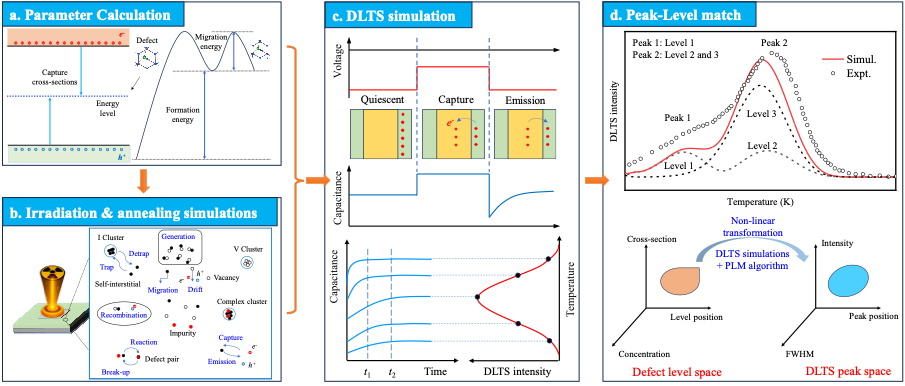
First principles-driven multiscale modeling framework for the multidimensional identification of deep-level defects in irradiated semiconductors (Image by LI Yonggang)