



A research team led by Prof. SHAO Dingfu from the Hefei Institutes of Physical Science, Chinese Academy of Sciences, has proposed a universal mechanism that enables deterministic electrical control of collinear antiferromagnets—overcoming a long-standing bottleneck in antiferromagnetic spintronics.
The study was published in Physical Review Letters.
Antiferromagnets are promising candidates for next-generation memory because they generate no stray magnetic fields and operate at ultrafast terahertz frequencies. However, their perfectly compensated magnetic structure makes the Néel vector—the quantity that stores information—extremely difficult to switch using conventional electrical methods.
In this study, the team moved beyond idealized bulk crystals and focused on realistic thin-film devices. In such structures, interfacial symmetry is naturally broken. When a spin current is injected into the film, the two magnetic sublattices no longer absorb equal spin accumulation. This microscopic imbalance generates what the researchers term an “asymmetric spin torque.”
"The process is like a seesaw," explained Prof. Shao, "If equal forces are applied on both sides, the system only oscillates. But even a slight imbalance will decisively tip it."
Similarly, uniform spin injection merely drives rapid oscillations of the Néel vector, failing to achieve deterministic switching. In contrast, asymmetric spin torque enables a reliable flip of the Néel vector, making controlled data writing possible. Notably, this mechanism parallels the well-established Spin-Transfer Torque and Spin-Orbit Torque techniques used in ferromagnetic devices, ensuring technological compatibility.
The model also shows that antiferromagnets are unusually robust. Unlike ferromagnets, their strong internal exchange coupling protects the Néel vector, which remains stable even under magnetic fields up to ten times the anisotropy field—matching experimental results in A-type antiferromagnet Cr₂O₃ under a 3-tesla field
This asymmetric spin torque framework is theoretically applicable to all collinear antiferromagnets. By eliminating the need for rare symmetry-specific materials, it bridges conventional ferromagnetic spintronics and emerging antiferromagnetic technologies, opening a practical pathway toward highly efficient, ultrafast memory devices.
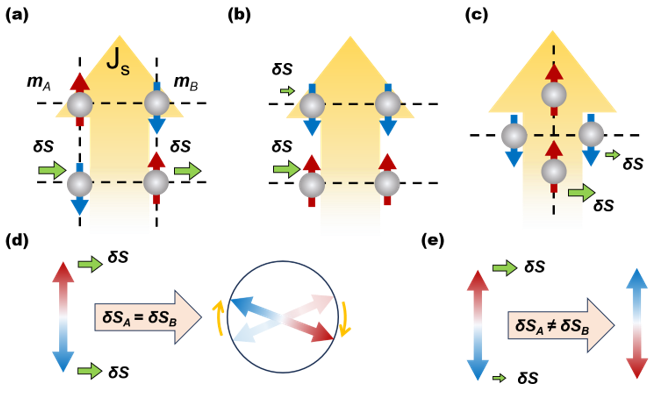
Schematic illustrations of the physical mechanism underlying asymmetric spin torque in antiferromagnetic systems. At the interface of thin films or devices, symmetry reduction results in unequal absorption of the injected spin current by the A and B sublattices of the antiferromagnet, thereby generating an asymmetric spin torque that drives deterministic switching of the Néel vector. (Image by SHAO Dingfu)