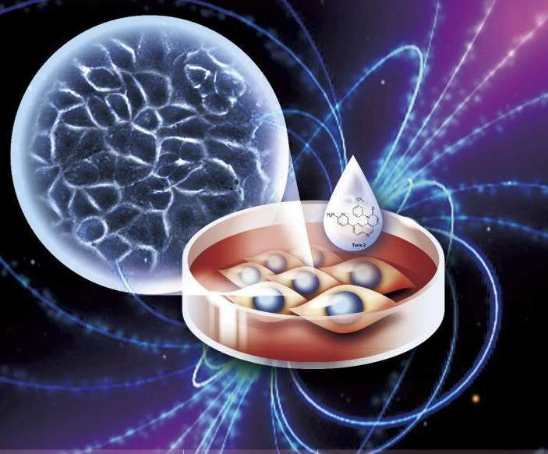
Recently, a research team from the Stable High Magnetic Field Facility (SHMFF) at the Hefei Institutes of Physical Science of the the Chinese Academy of Sciences, led by Academician XIE Yi and Professor ZHANG Xiaodong, proposed a surface halogen (Cl, Br, and I) passivation strategy to significantly improve the stability of photocatalysts.
The study was published in the Journal of the American Chemical Society.
Transition metal sulfides are promising photocatalysts for high-value chemical synthesis, but their practical applications are often limited by severe photocorrosion and rapid deactivation during reactions.
To address this challenge, the research team developed a surface halogen passivation strategy that forms a protective barrier against chemical attack, effectively preventing oxidative and reductive degradation of the catalyst surface.
Using cadmium sulfide (CdS), a typical metal sulfide photocatalyst, as a model system, the researchers demonstrated that introducing surface halogen atoms (Cl, Br, or I) can effectively suppress the leakage of sulfur or cadmium ions under continuous photoirradiation. In contrast, pristine CdS undergoes significant structural damage under the same conditions. Meanwhile, the halogen-passivated catalysts exhibit enhanced photocatalytic efficiency due to accelerated charge-transfer kinetics, which facilitate exciton dissociation and interfacial electron transport.
The Electron Paramagnetic Resonance Spectrometer (EPR) at SHMFF played a crucial role in uncovering the underlying mechanism. By capturing free radical signals during the reaction and monitoring the evolution of material defect states, the EPR measurements revealed how halogen passivation—particularly chlorine—promotes charge transfer while suppressing photocorrosion.
As a result, the halogen-passivated catalysts, denoted as CdS–Hal (Hal = Cl, Br, I), demonstrated excellent performance and stability in methanol activation and the methylation of heterocyclic aromatic hydrocarbons.
This work provides valuable insights into the rational design of surface structures for semiconductor photocatalysts and offers a promising strategy for advancing technologies in small-molecule activation and solar-to-chemical energy conversion.
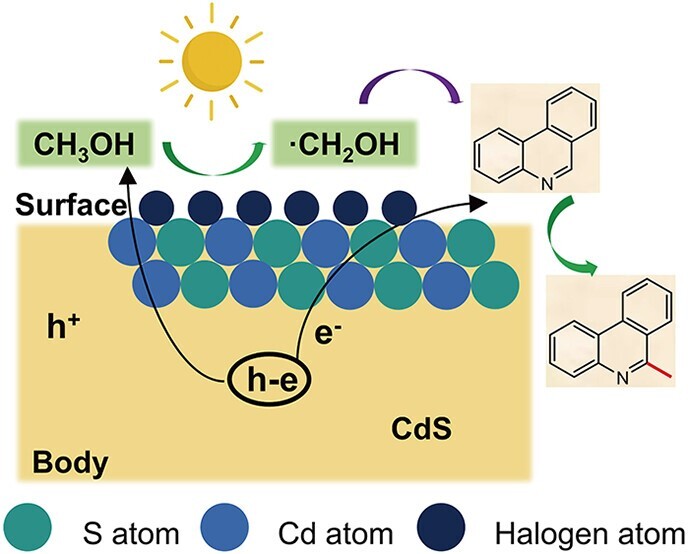
Schematic diagram of surface halogen (Cl, Br and I) passivation (Image by LI Jingxin)
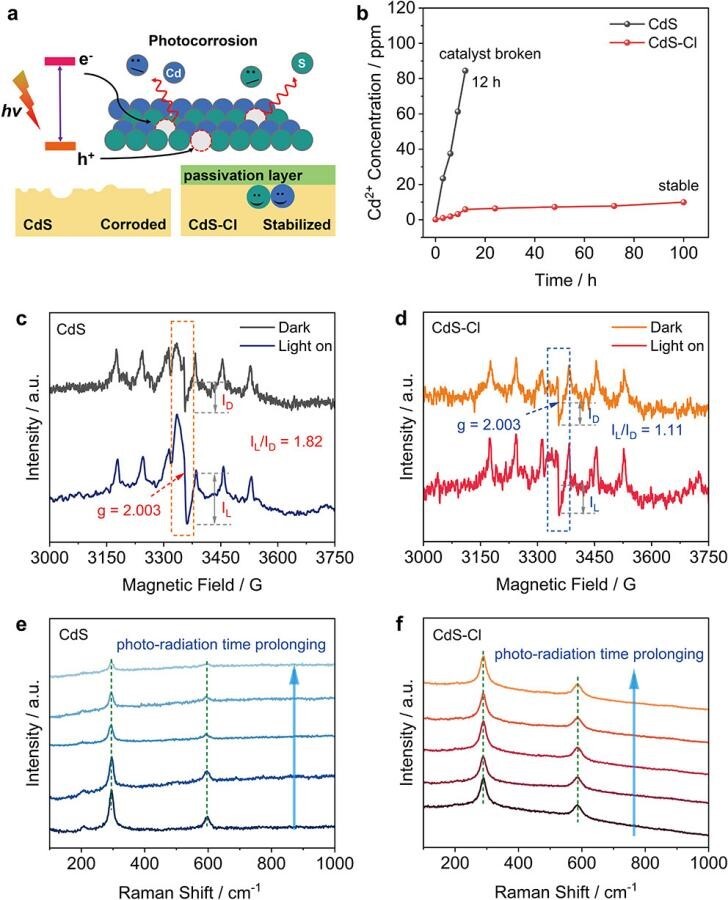
Photostability studies (Image by LI Jingxin)