A research team led by Professor WANG Peng from the Hefei Institutes of Physical Science, Chinese Academy of Sciences, in collaboration with international partners, has published a comprehensive review on liquid–liquid phase separation (LLPS)-driven membraneless organelles (MLOs) and their emerging applications in biotechnology.
The review appears in Synthetic and Systems Biotechnology.
In this article, the authors systematically summarize the design principles and construction strategies of synthetic MLOs from three key perspectives: scaffold molecule types, client recruitment strategies, and characterization approaches. By integrating recent advances in the field, the review provides a clear framework for engineering programmable phase-separated systems in living cells.
The paper also highlights a wide range of practical applications. Synthetic MLOs have shown great potential in metabolic pathway reprogramming, enzyme activity enhancement, gene expression regulation, high-yield recombinant protein production and purification, biomaterial development, and molecular delivery. By spatially organizing biomolecules into membrane-free microreactors, these condensates improve reaction efficiency and enable more precise cellular control.
"In recent years, LLPS-driven membraneless organelles have evolved from a biological curiosity into a practical engineering toolkit," said Dr. SUN Manman, a member of the team, "These programmable, membrane-free compartments enhance bioproduction efficiency, allow safer expression of toxic products, and create new opportunities for green manufacturing and precision medicine."
Researchers further emphasize the promise of artificial MLOs in reducing product cytotoxicity and facilitating the biosynthesis of high-value or otherwise toxic compounds. They point out that advances in AI-assisted protein design, high-resolution imaging, and high-throughput screening technologies will accelerate the development of more stable, controllable, and orthogonal phase-separation systems. Such progress is expected to provide a solid foundation for next-generation programmable cell factories, functional biomaterials, and precision drug delivery platforms.
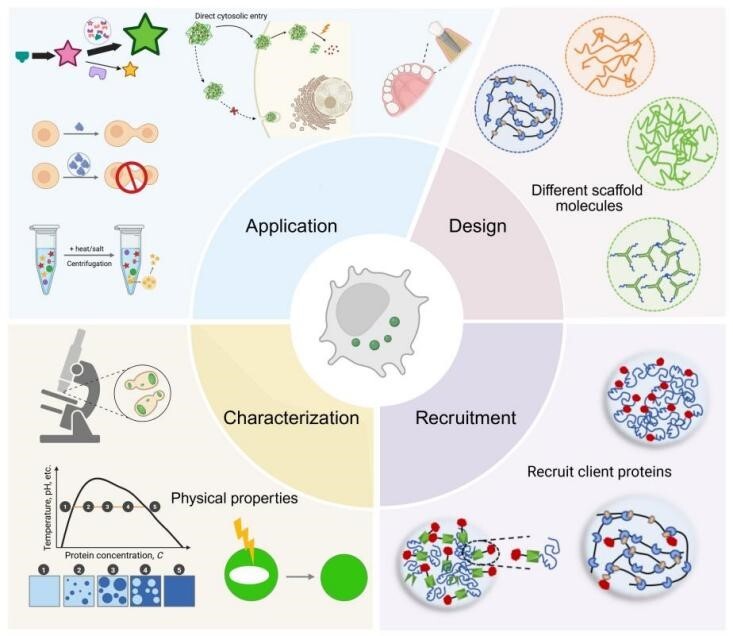
Construction and applications of membraneless organelles (Image by SUN Manman)