A research team led by Professor XU Guosheng from the Institute of Plasma Physics, Hefei Institutes of Physical Science, Chinese Academy of Sciences, have for the first time demonstrated, in a metal-wall environment, a plasma regime that simultaneously achieves partial divertor detachment, an edge-localized-mode (ELM)-free high-confinement mode (H-mode), and high pedestal performance.
This integrated regime was sustained on a minute-scale and has been published in Physical Review Letters recently.
Controllable nuclear fusion requires managing extreme heat loads on divertor plates while maintaining plasma stability. While impurity gases can reduce divertor heat through detachment, excessive cooling can damage the plasma edge, and H-mode plasmas are prone to sudden, damaging ELMs. Achieving a steady-state regime that addresses both challenges has been a major international goal.
In this work, the team controlled the injection of light impurity gases to create a new plasma regime on the EAST tokamak, called the Detached divertor and Turbulence-dominated Pedestal (DTP) regime.
By fine-tuning gas seeding in real time, they achieved partial divertor detachment while maintaining plasma stability. In this regime, heat flux to the divertor plates was greatly reduced, ELMs were completely suppressed, and the pedestal electron temperature increased significantly, improving overall energy confinement. The partial detachment, combined with a closed divertor geometry, trapped and pumped neutral particles, reducing pedestal cooling and enhancing the temperature gradient. This stronger gradient drove micro-turbulence, identified as temperature-gradient-driven trapped electron modes, which naturally transported particles and heat outward. This transport channel limited pedestal pressure buildup, prevented ELMs, and maintained steady, high-performance plasma on a minute-scale—a major step toward stable, long-pulse fusion operation.
This research offers a potential solution to the long-standing challenge of balancing divertor heat load management with efficient plasma confinement, according to the team.
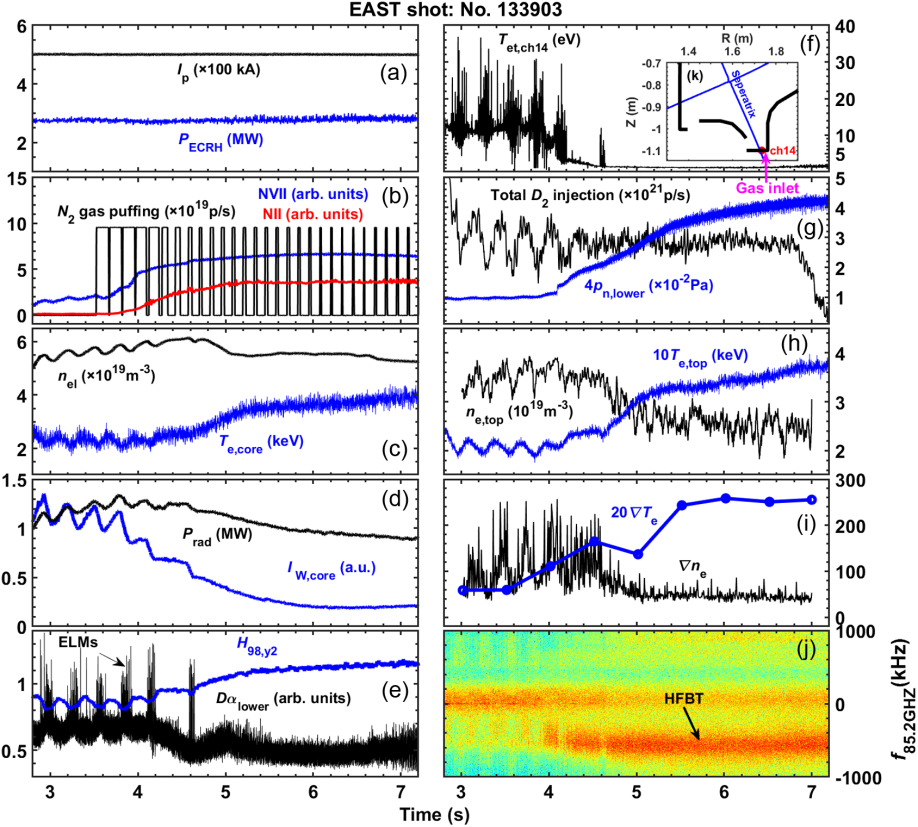
Achievement of partial divertor detachment, ELM suppression, and marked improvement in pedestal performance via light impurity injection. (Image by DING Genfan)
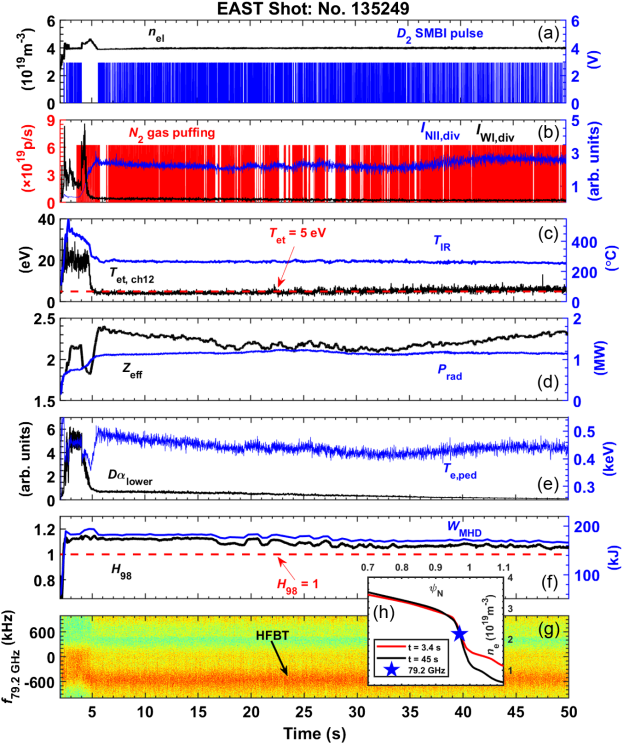
Achievement of high-performance long-pulse operation compatible with ELM-free state and divertor detachment via light impurity injection. (Image by DING Genfan)