



Recently, the team led by Prof. LU Qingyou at the High Magnetic Field Laboratory, the Hefei Institutes of Physical Science (HFIPS) of the Chinese Academy of Sciences, together with Prof. LUO Xuan and SUN Yuping from the Institute of Solid State Physics of HFIPS, systematically revealed lattice-driven topological spin structures in Cr2Ge2Te6 single crystals.
They used a self-developed low-temperature, high-magnetic-field magnetic force microscope (MFM) based on the Steady High Magnetic Field Facility.
These results were published as a cover article in Advanced Functional Materials.
Topological spin structures have attracted much attention because of their stability and tunability, as well as their potential applications in advanced information technologies. They are generally believed to originate from magnetic interactions and external perturbations. However, whether the lattice can directly shape these structures in layered van der Waals magnets has remained unclear.
In this work, the researchers studied Cr2Ge2Te6 single crystals, which have a layered van der Waals structure, strong magnetocrystalline anisotropy, and strong interlayer coupling. These features make the material a good platform for studying two-dimensional magnetism and spin topology.
MFM images revealed clear topological spin structures with shapes ranging from triangles to octagons. Combined with electron spin resonance measurements and micromagnetic simulations, the researchers found that these structures were closely related to lattice symmetry and local structural distortions, rather than forming randomly.
The results suggest that the lattice can create competing local energy states that help stabilize these spin structures, which differs from the conventional understanding that such structures mainly arise from interfacial Dzyaloshinskii–Moriya interactions.
Further experiments showed that these structures could change under applied magnetic fields, including transitions between different topological states. Some structures also showed particle-like behaviors such as splitting and merging, indicating that they can be tuned by external magnetic fields.
The study revealed a close connection between crystal symmetry and topological magnetism, providing new insight into magnetic structures in low-dimensional materials.
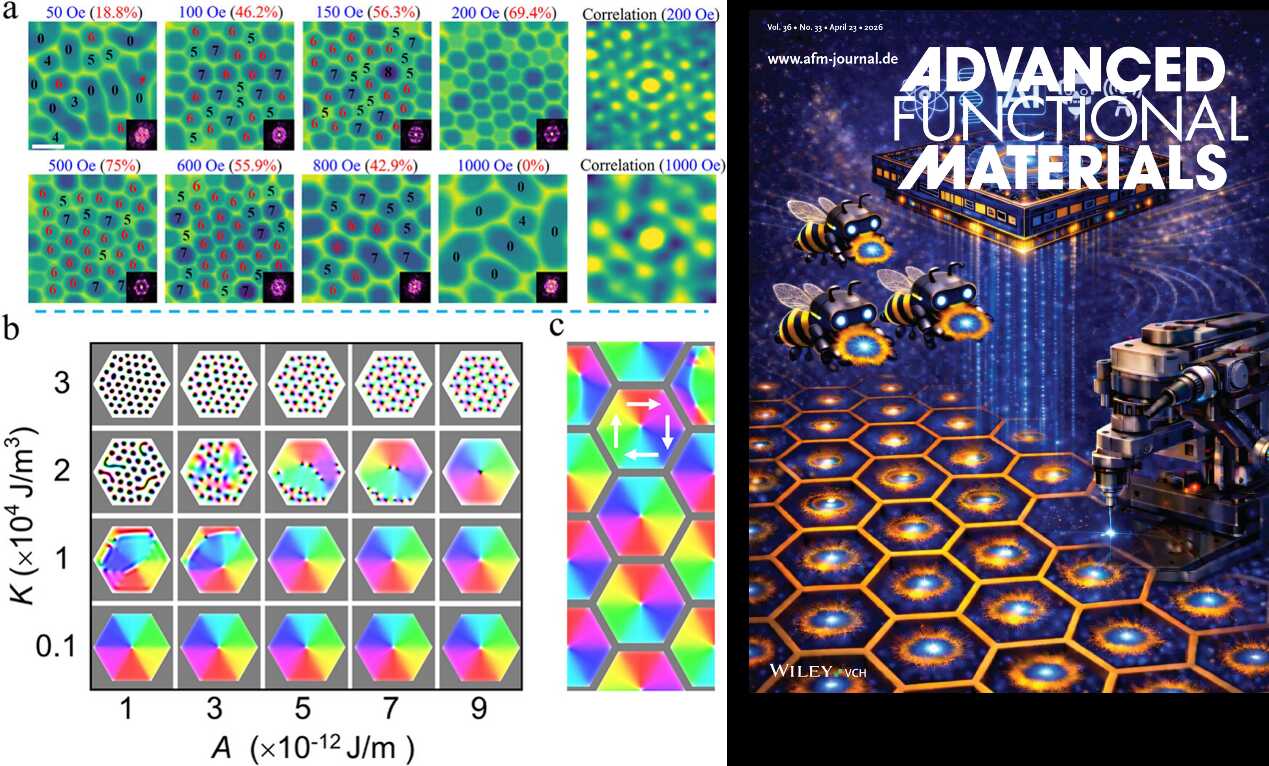
Controllable construction and microscopic mechanism of lattice-driven topological spin structures. Selected as a cover article. (Image by FENG Qiyuan)