A research team led by Prof. ZHENG Guolin at the Chinese High Magnetic Field Laboratory, the Hefei Institute of Physical Science of the Chinese Academy of Sciences has realized a superconducting diode effect that preserves time-reversal symmetry in NbSe2 homojunctions. The device was built using a solid-state proton gating technique to form n–n, p–n and p–p junctions, all operating under zero magnetic field.
The work has been published in Physical Review X.
Most existing approaches to realizing the superconducting diode effect rely on breaking time-reversal symmetry, often through an external magnetic field or magnetic materials, which limits the device integration.
In this study, the researchers tuned the carrier concentration and carrier type in NbSe2, fabricating n–n, p–n, and p–p superconducting homojunctions. All three types of junctions exhibited clear diode-like behavior, allowing supercurrent to flow more easily in one direction than the other, even in the absence of an applied magnetic field.
The direction of the diode effect depended on the type of junction: n–n devices showed an opposite polarity compared with p–n and p–p structures. Measurements also showed that the asymmetry remained unchanged under magnetic field variations, confirming that time-reversal symmetry was not broken.
The researchers attribute the effect to the movement of protons at the junction under an applied current, which influences the transition between superconducting and resistive states under opposite bias directions.
The results provide a new route to designing superconducting diode devices without relying on time-reversal symmetry breaking, according to the team.
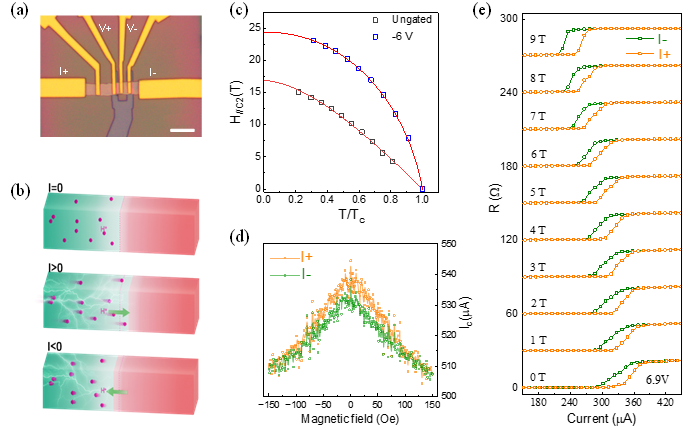
A general framework for time-reversal symmetric superconducting diode effect (Image by ZHENG Guolin)