



A research team led by Prof. Zhang Tianshu at the Anhui Institute of Optics and Fine Mechanics, Hefei Institutes of Physical Science, Chinese Academy of Sciences, has developed a compact laser system for non-Doppler wind lidar applications, offering a low-cost and highly deployable solution for near-surface wind field sensing.
The study, published in Optics Express, addresses key limitations of conventional Doppler lidar systems, which are often expensive, complex, and difficult to deploy in harsh or space-constrained environments.
Near-surface wind fields play an important role in applications such as the low-altitude economy, wind energy optimisation, and aviation safety. However, traditional systems rely on complex frequency-shift detection and precise optical alignment, limiting their broader use in real-world scenarios.
In this study, the team designed a compact Nd:YAG master oscillator power amplifier (MOPA) laser pumped by dual single-emitter diodes. The design separates pumping for the oscillator and amplifier stages, combined with a two-stage temperature control scheme and a double-pass amplification configuration, significantly improving thermal stability and energy efficiency while keeping the system compact.
The laser operates stably at a repetition rate of 3.96 kHz, generating nanosecond pulses with microjoule-level energy and excellent beam quality. Its output remains highly stable across an ambient temperature range of 30–50°C, with power fluctuations controlled within ±3% and beam pointing drift below 50 μrad.
When integrated into a scanning-free, multi-beam non-Doppler lidar system, the compact laser supports continuous 24-hour measurements of near-surface wind profiles. Field experiments demonstrate strong consistency with in-situ meteorological observations in both wind speed and direction.
With a total weight of only 400 grams, the system is highly compact and suitable for deployment on mobile platforms such as medium-sized unmanned aerial vehicles.
The work demonstrates a practical approach to improving the accessibility and flexibility of wind lidar measurements in real-world environments, according to the team.
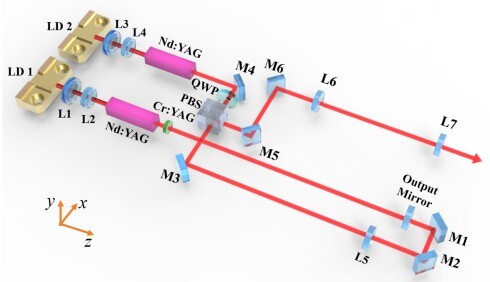
Fig. 1. Experimental setup of the MOPA laser system (Image by CHEN Jinxin)
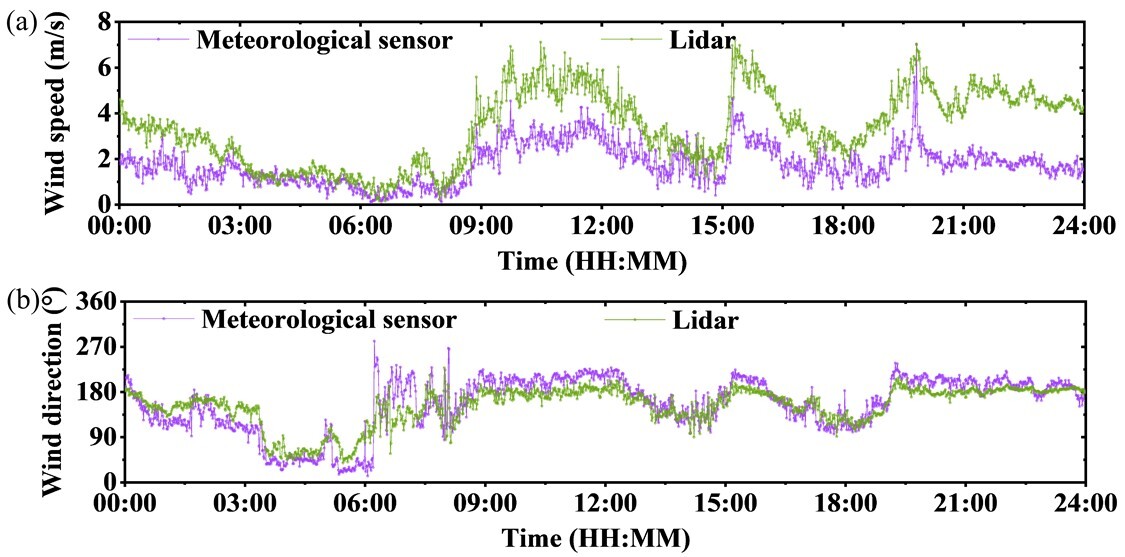
Fig. 2. 24 h continuous wind field observation results of the lidar and ground meteorogical sensor.
(a) Time series of wind speed. (b) Time series of wind direction. (Image by CHEN Jinxin)