



A research team led by Prof. JIANG Changlong from the Hefei Institutes of Physical Science of the Chinese Academy of Sciences have developed a new porous material that can both detect and adsorption copper ions (Cu2+) from complex environments.
The study was published in ACS Nano.
Porphyrin-based covalent organic frameworks (COFs) possess immense potential in adsorption, catalysis, and sensing due to their ordered pores and unique optical properties; however, their practical application remains restricted. Their indiscriminate coordination with various metals hinders the specific recognition of target heavy metal ions. Furthermore, these COFs typically exist as hard-to-process insoluble powders and suffer from solid-state fluorescence quenching via strong π-π stacking, severely limiting their analytical and adsorptive utility.
To solve these problems, the team designed a porphyrin-based COF with a special dual-bridged structure. The structure improves the material' s ability to recognize Cu2+ while maintaining its optical properties.
The researchers further combined the COF material with polyvinyl alcohol to create a lightweight porous aerogel. This design reduces the stacking between COF layers and helps maintain strong fluorescence signals.
When Cu2+ is present, the material captures the ions and produces a visible fluorescence color change from red to light blue, allowing rapid detection. The material can detect Cu2+ at very low concentrations, with a detection limit of 40.76 nM. It also shows a high adsorption capacity of 1902 mg/g, enabling efficient adsorption of Cu2+ from contaminated environments.
Tests using real soil samples showed that the material could effectively detect and adsorption copper ions under complex conditions.
The study provides a simple approach for designing multifunctional porous materials and may contribute to future technologies for heavy metal monitoring and pollution treatment.
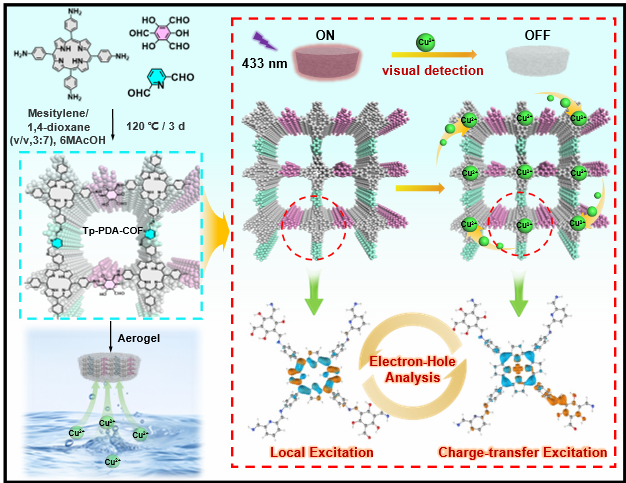
Study on Synthesis Strategies of Dual-Bridged Porphyrin-Based Covalent Organic Frameworks and Their Fluorescence Sensing and Synergistic Adsorption Mechanisms. (Image by YANG Fan)