A collaborative team from Hefei Institutes of Physical Science, Chinese Academy of Sciences, has developed a quantum-enhanced method that improves abnormal signal detection in EAST tokamak diagnostic data while significantly reducing computational requirements compared with conventional deep learning approaches.
By combining classical data processing techniques with quantum machine learning, the method integrates efficient signal analysis with quantum computing to improve the performance of diagnostic data processing.
Fusion experiments generate large volumes of diagnostic data, but signal interference and disturbances can make anomaly detection challenging. Traditional approaches may struggle to capture complex signal features, while data-driven methods often depend on extensive computational resources.
In this study, the researchers combined Koopman operator theory, a mathematical approach for analyzing complex dynamic systems, with quantum neural networks. The method first extracts key information from complex diagnostic signals and reduces data dimensions before processing the data with quantum circuits.
Tests using 4,763 labeled signal sequences from EAST diagnostics showed that the new method achieved about 97.0% accuracy in detecting abnormal signals, close to the 98.0% accuracy of a conventional deep learning model. However, it used only about 0.2% of the trainable parameters required by the deep learning model, making it more suitable for current quantum computing devices with limited resources.
The researchers also tested the method under simulated quantum hardware limitations, including measurement errors and signal disturbances. The system maintained an accuracy above 96.2% with a limited number of quantum measurements and remained reliable under stronger interference conditions.
The modular design allows quantum computing tasks to be distributed across smaller quantum processors, providing a practical pathway for applying quantum machine learning to complex fusion data analysis.
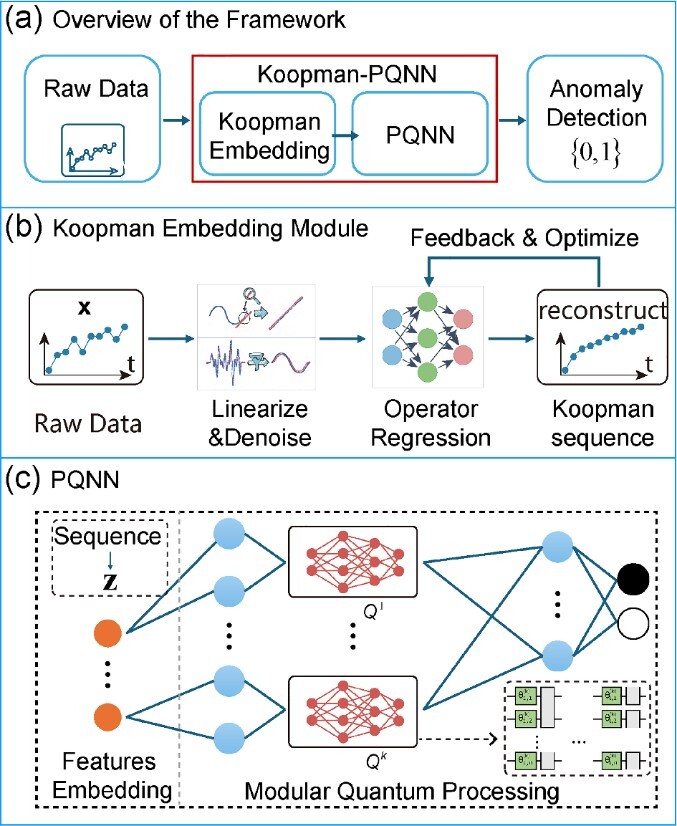
Schematic diagram of the algorithm: (a) Classical-quantum hybrid framework; (b) Koopman embedding module; (c) Parallel quantum neural network (PQNN). (Image by LAN Ting)