A research team led by Prof. MENG Guowen and Prof. HAN Fangming from the Institute of Solid State Physics, Hefei Institutes of Physical Science, Chinese Academy of Sciences, in collaboration with Prof. WEI Bingqing from the University of Delaware, has developed a highly crystalline three-dimensional graphitic carbon tube grid (3D-GCTG) that significantly improves the performance of filtering supercapacitors with thick electrodes.
The new material helps maintain fast frequency response while increasing capacitance, offering a potential solution for developing smaller and more efficient electronic devices.
The study was published in Advanced Materials.
With the increasing demand for compact and high-performance electronic devices, supercapacitors have emerged as promising alternatives to conventional aluminum electrolytic capacitors for AC line filtering due to their fast charge-discharge capability. However, traditional porous carbon electrodes often suffer from poor high-frequency performance, especially when electrode thickness increases. The research team found that improving the crystallinity of the carbon framework could enhance electrical conductivity and maintain fast charge transport in thick electrodes, but constructing highly crystalline carbon structures while preserving three-dimensional architectures remained challenging.
In this study, the team used a three-dimensional interconnected nickel nanorod grid as both a structural template and catalyst to construct the 3D-GCTG structure. By carefully controlling the growth process, they preserved the integrity of the nickel framework during graphitization, allowing highly crystalline graphitic carbon tubes to form while maintaining interconnected channels for ion transport.
The highly crystalline carbon framework improved electron transport within the electrode. Compared with a similar three-dimensional carbon tube grid with lower crystallinity, the 3D-GCTG showed faster coupled electron and ion transport, especially in thicker electrodes.
The material also demonstrated strong performance under high mass loading. Even with an electrode thickness of 40 micrometers, the 3D-GCTG maintained a phase angle below −80° at 120 Hz, while its areal capacitance reached 3.77 mF cm-2, about 3.6 times that of the previously reported non-crystalline three-dimensional graphitic carbon tube structures.
To further evaluate its practical potential, the researchers assembled six 3D-GCTG-based supercapacitors in series to achieve an operating voltage of 6 V. The device successfully converted 60 Hz AC signals, including sine, square, and triangular waves, into stable DC output, demonstrating its potential for AC line-filtering applications.
The study provides a new approach for designing carbon-based electrode materials with both high conductivity and efficient ion transport.
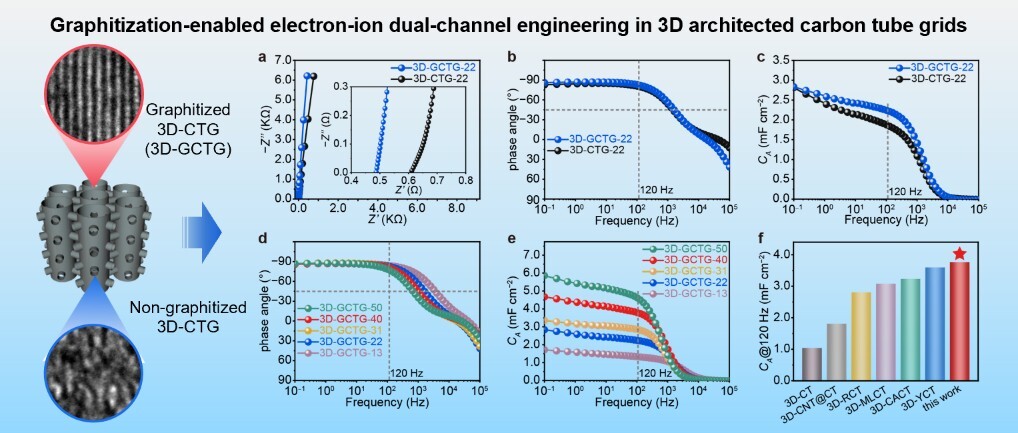
Structural schematics and electrochemical performance of 3D-GCTG and 3D-CTG (from 3D nanoporous anodic aluminum oxide template-assisted chemical vapor deposition). (Image by HAN Fangming)