Researchers using the Steady High Magnetic Field Facility at the Hefei Institutes of Physical Science, Chinese Academy of Sciences, together with collaborators from Anhui Medical University, the University of Science and Technology of China, the Hong Kong University of Science and Technology and other institutions, have found that zinc doping changes the superconducting properties of iron selenide (FeSe) in an unexpected way while preserving its two-gap superconducting state.
The findings, published in Physical Review B, provide new experimental evidence for understanding how superconductivity works in iron-based materials.
FeSe is a widely studied iron-based superconductor with a relatively simple crystal structure, making it a useful material for investigating how superconductivity develops. However, the nature of its superconducting state, including the symmetry and structure of its energy gap, remains under debate.
In this study, the researchers introduced zinc, a nonmagnetic element, into FeSe crystals. They found that zinc atoms entered the crystal structure and caused local distortions and defects, increasing the scattering of electrons as they moved through the material.
As the zinc concentration increased, the superconducting transition temperature did not change steadily. It first decreased, then increased, and finally decreased again at higher doping levels. This behavior suggests that the effects of impurity scattering compete with those of the material's multiband electronic structure, rather than simply weakening superconductivity.
Measurements of the low-temperature specific heat also showed that the superconducting state is better described by two energy gaps than by a single-gap or d-wave model. One gap has an anisotropic extended s-wave structure, while the other is an isotropic s-wave gap. Notably, their relative contributions remained nearly unchanged as the zinc concentration varied, suggesting that zinc-induced scattering between different electronic bands is relatively weak.
These findings show that FeSe retains its two-gap superconducting state despite zinc doping, offering new insights into superconductivity in iron-based materials.
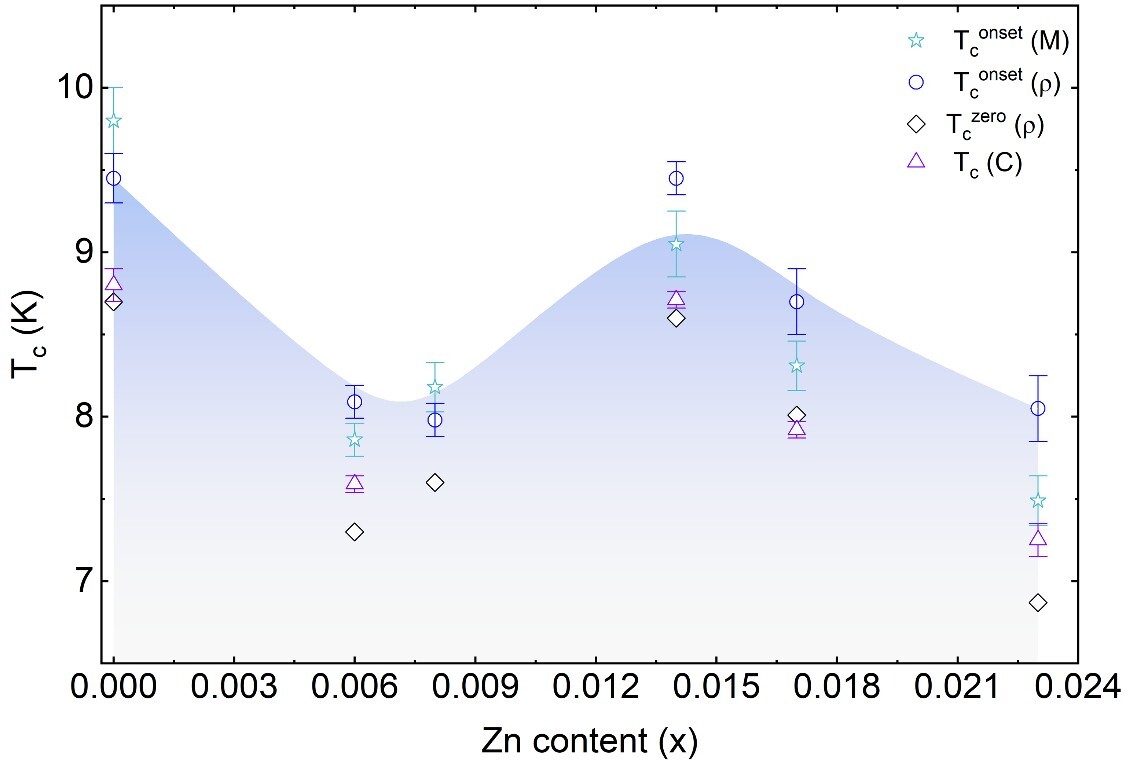
Phase diagram of Zn-substituted FeSe single crystals, Fe1−xZnxSe, as a function of Zn concentration x. The Tc are determined from magnetization (M), resistivity (ρ), and specific-heat (C) measurements. (Image by HAN Yuyan)