Researchers from the High Magnetic Field Laboratory of the Hefei Institutes of Physical Science, Chinese Academy of Sciences, in collaboration with the Hong Kong University of Science and Technology, have developed a unified symmetry criterion for identifying and classifying unconventional magnets. The framework brings previously separate classification rules into a single system, making it easier to identify potential new magnetic materials and understand their properties.
The findings were published in Newton, a journal published by Cell Press.
Unconventional magnets combine two important properties: their overall magnetization is compensated, like that of antiferromagnets, while their electrons can exhibit spin splitting similar to that found in ferromagnets. These features make them promising materials for next-generation spintronic devices. However, different families of unconventional magnets have distinct symmetry properties, making them difficult to classify within a single framework.
In this study, the team developed the framework based on spin space groups, which describe the symmetry of magnetic structures and electron spins. They identified six key symmetry operations that can be used to determine the spin texture in momentum space and classify the resulting spin splitting. By examining these operations, researchers can establish whether a magnet has a collinear, coplanar or noncoplanar spin arrangement, and whether its spin splitting belongs to the even-parity or odd-parity family.
The new classification also challenges several existing assumptions about unconventional magnets. The researchers found that odd-parity magnets do not necessarily require coplanar magnetic structures or a combination of time-reversal and translation symmetry. They also showed that coplanar magnets can exhibit collinear even-parity spin splitting through a mechanism different from that found in altermagnets. These findings expand the understanding of how different magnetic structures can produce unconventional spin splitting.
To explore the range of materials covered by the new framework, the team applied it to MAGNDATA, a database of experimentally reported magnetic structures. They identified 33 candidate odd-parity magnets and 60 candidate even-parity magnets, excluding known altermagnets.
Beyond identifying candidate materials, the researchers developed a theoretical model showing that an odd-parity magnet could support protected helical edge states. This suggests a possible link between unconventional magnetism and topological quantum phenomena.
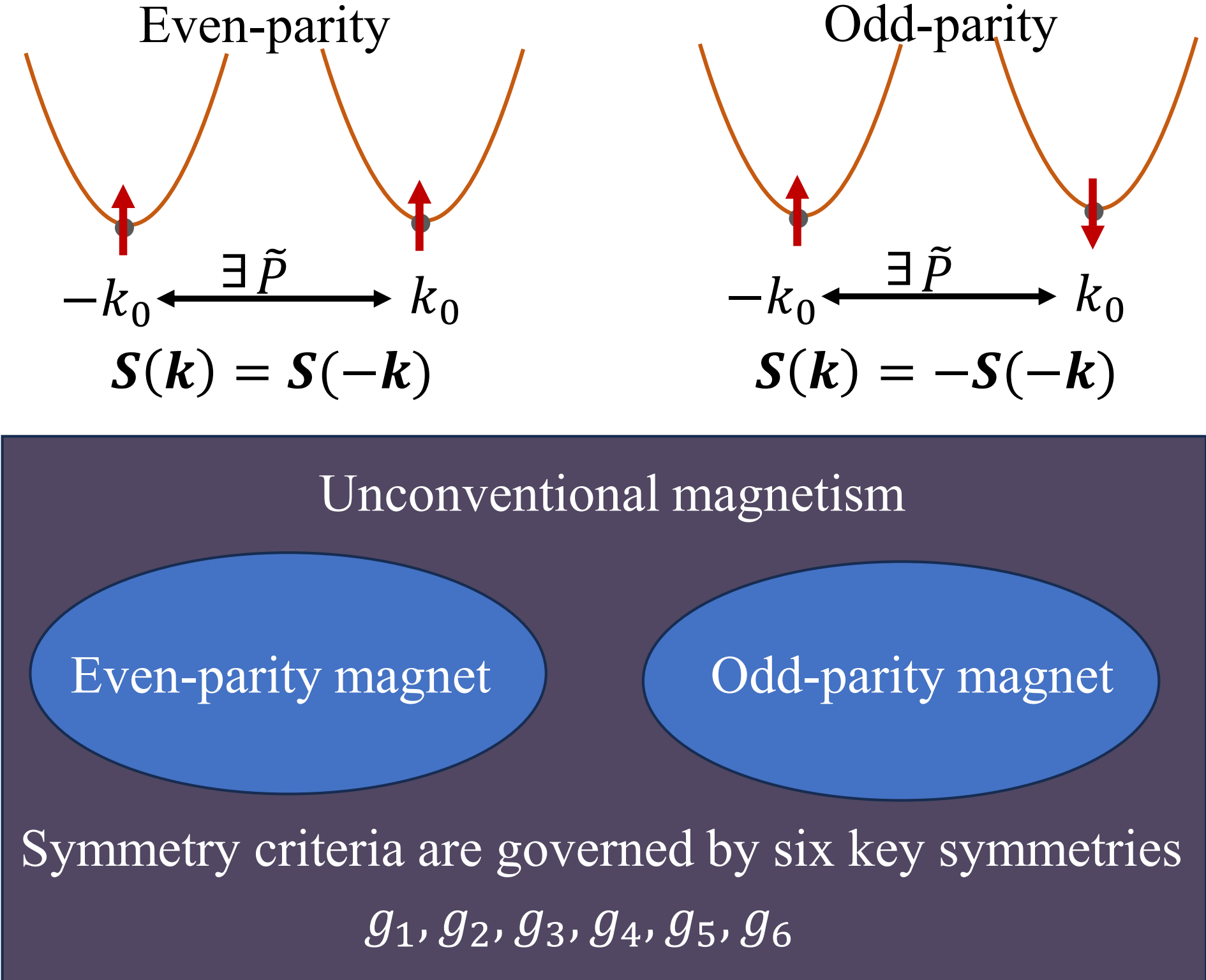
Unconventional magnetism falls into two classes, even-parity magnets and odd-parity magnets, whose symmetry criteria are governed by six key spin-group symmetries, g1-g6. (Image by LUO Xunjiang)