


A research team led by Prof. HAO Ning of the Hefei Institutes of Physical Science of the Chinese Academy of Sciences, in collaboration with Anhui University and the University of Science and Technology of China, has identified two distinct types of unusual low-energy quasiparticle states in the kagome superconductor CsV3Sb5 using single-atom impurities as local "quantum probes" combined with scanning tunnelling spectroscopy.
The study was recently published in Nature Physics.
CsV3Sb5 has attracted growing interest for its unusual crystal structure and complex quantum phenomena. Evidence for time-reversal symmetry breaking remains under debate, and the mechanism of its superconductivity is still not fully understood. Studying its response to single-atom impurities provides a promising way to address these questions.
Using an ultralow-temperature, high-magnetic-field scanning tunnelling microscope, the team systematically investigated artificially introduced magnetic and non-magnetic impurities, as well as intrinsic vanadium vacancies. They found that magnetic chromium adatoms produce pronounced Kondo resonance peaks. Remarkably, the spatial pattern of these resonances breaks all in-plane mirror symmetries of the kagome lattice—an effect that cannot be explained by conventional charge-density-wave order or electronic nematicity, but aligns with theoretical models involving chiral loop-current order.
In addition, near weakly magnetic vanadium vacancies, the researchers observed a pronounced zero-bias conductance peak within the superconducting gap. This zero-energy mode coexists with conventional bound states but remains spatially robust and shows behavior close to quantized conductance. Analysis suggests it arises from local oscillations of the superconducting order parameter induced by magnetic impurities. In the presence of topological surface states, such features may be linked to Majorana zero modes.
These results offer new insight into defect-induced exotic excitations in topological superconductors, according to the team.
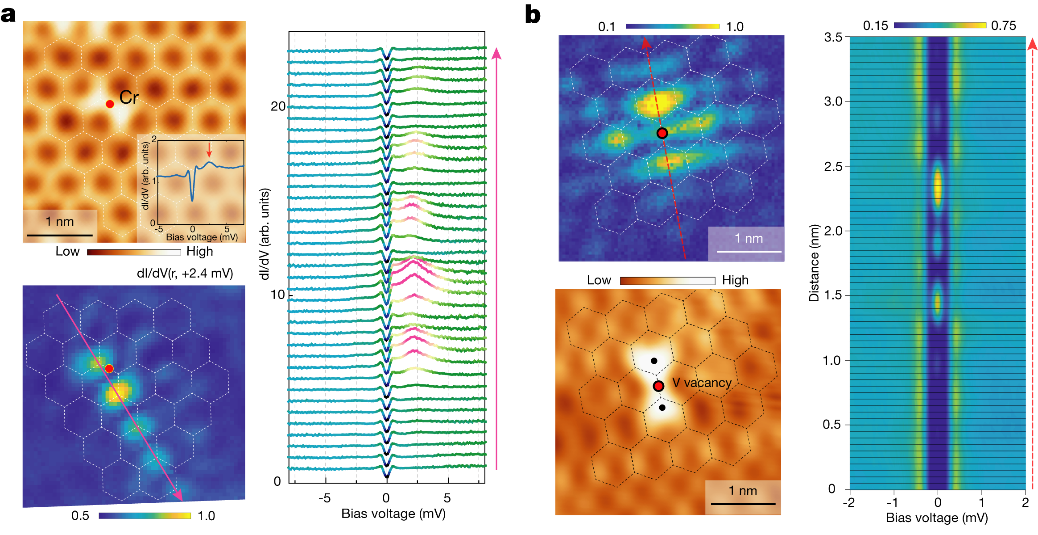
a, Kondo state near a Cr atom with complete breaking of spatial symmetry. b, Zero-bias conductance peak induced by a V vacancy. (Image by XIAO Yuhang)