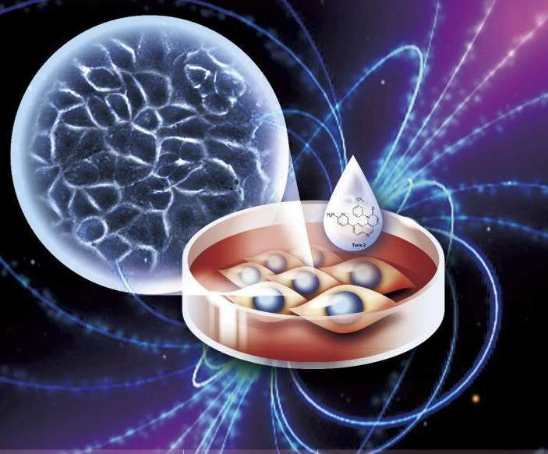
Recently, a research team led by Prof. LIU Qingsong at the Institute of Health and Medical Technology, the Hefei Institutes of Physical Science of the Chinese Academy of Sciences, has discovered a new drug candidate that may help overcome chemotherapy resistance in small cell lung cancer (SCLC).
The study, published in Signal Transduction and Targeted Therapy, introduces a compound called IHMT-15137, which works by blocking a key signaling pathway linked to drug resistance.
SCLC is a fast-growing and highly aggressive type of lung cancer, accounting for about 15% of all cases. Most patients are diagnosed at an advanced stage. While chemotherapy remains the standard first-line treatment, many patients quickly develop resistance, leading to a very low five-year survival rate of around 7%. Finding new ways to improve treatment outcomes is therefore a major priority.
The researchers found that BMX and E2F1, proteins linked to cell growth and survival, are highly active in tumor samples and drug-resistant cancer cells. Further investigation showed that BMX helps stabilize E2F1, allowing cancer cells to continue growing, repairing damage, and spreading, even under chemotherapy. This process plays a key role in making the cancer resistant to treatment.
Based on this finding, the team developed IHMT-15137, a molecule that specifically blocks BMX activity. By doing so, it disrupts the downstream signals and reduces E2F1 levels, making cancer cells more sensitive to treatment.
Laboratory tests showed that IHMT-15137, when used together with the chemotherapy drug cisplatin, produced strong anti-tumor effects in drug-resistant cancer cells, as well as in patient-derived tumor models. The combination treatment slowed tumor growth, triggered cancer cell death, and showed minimal side effects in animal studies.
"Our findings suggest a new way to overcome chemotherapy resistance in small cell lung cancer by targeting key proteins early in the pathway," said Associate Professor QI Shuang.
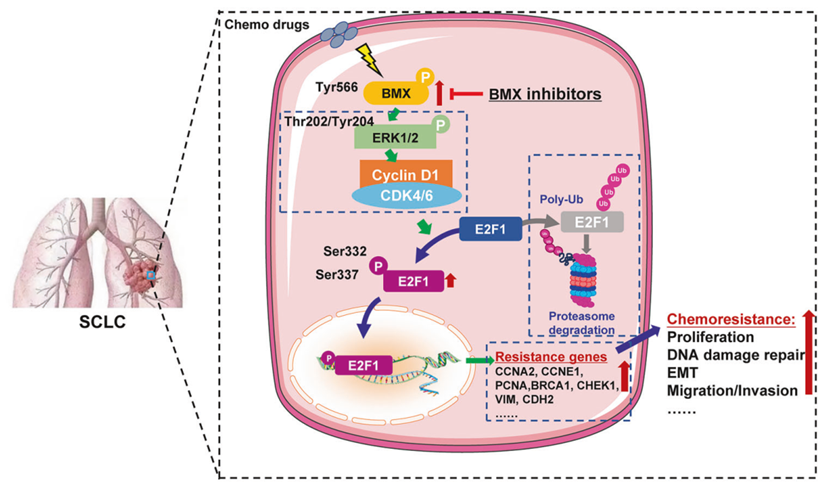
Mechanism model: Small-molecule inhibitor targets BMX-E2F1 axis to reverse SCLC chemoresistance. (Image by QI Shuang)
![Schematic illustration of (a) the preparation of Mn3[Co(CN)6]2@SiO2@Ag and (b) the delivery process of these Dox-loaded Mn3[Co(CN)6]2@SiO2@Ag to A549 cells for enhanced fluorescence imaging](../../../news/Events/201601/W020160122330206981460.png)