



A research team led by Professor LI Xiangxian from Hefei Institutes of Physical Science, Chinese Academy of Sciences, improved the accuracy of infrared monitoring of complex industrial flue gas under harsh operating conditions.
The results were published in Analytical Chemistry and Infrared Physics & Technology.
Real-time monitoring of high-temperature, multi-component flue gas is important for industrial emission control and carbon reduction. Fourier Transform Infrared (FTIR) spectroscopy is widely used because it can detect multiple gases at the same time with high sensitivity. However, in real industrial environments, limited instrument resolution and strong environmental interference often cause the relationship between infrared signals and gas concentrations to become nonlinear, which reduces measurement accuracy.
In this study, the team combined FTIR spectroscopy with machine learning methods to improve the reliability of gas concentration estimation under complex industrial conditions.
For carbon dioxide (CO2) measurement, they focused on identifying the most informative spectral regions and refining key signal features. This helps reduce distortion caused by signal saturation at high concentrations and improves the stability of the model. As a result, the prediction accuracy of CO2 under extreme conditions was improved under extreme conditions.
For carbon monoxide (CO) detection, they first applied baseline correction to minimize errors caused by background drift and instrument noise. They then selected spectral bands that avoid interference from overlapping signals of water vapor and carbon dioxide, ensuring cleaner input data for the model. Finally, optimization algorithms were introduced to fine-tune the model parameters, which further improved prediction stability and robustness in complex industrial environments.
Overall, the study provides a more practical approach for infrared-based gas monitoring in industrial settings. It improves the reliability of online measurements and may support better emission control and carbon reduction efforts in industry.
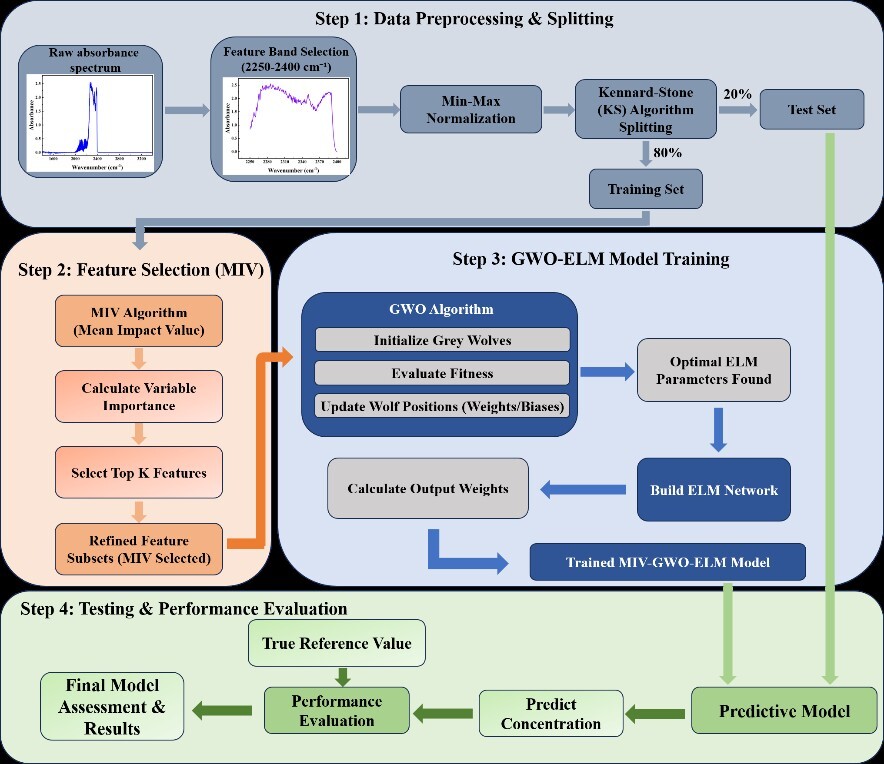
Operational mechanism of the mean impact value-enhanced gray wolf optimizer-based extreme learning machine (MIV-GWO-ELM) hybrid prediction model. (Image by LI Xiangxian)
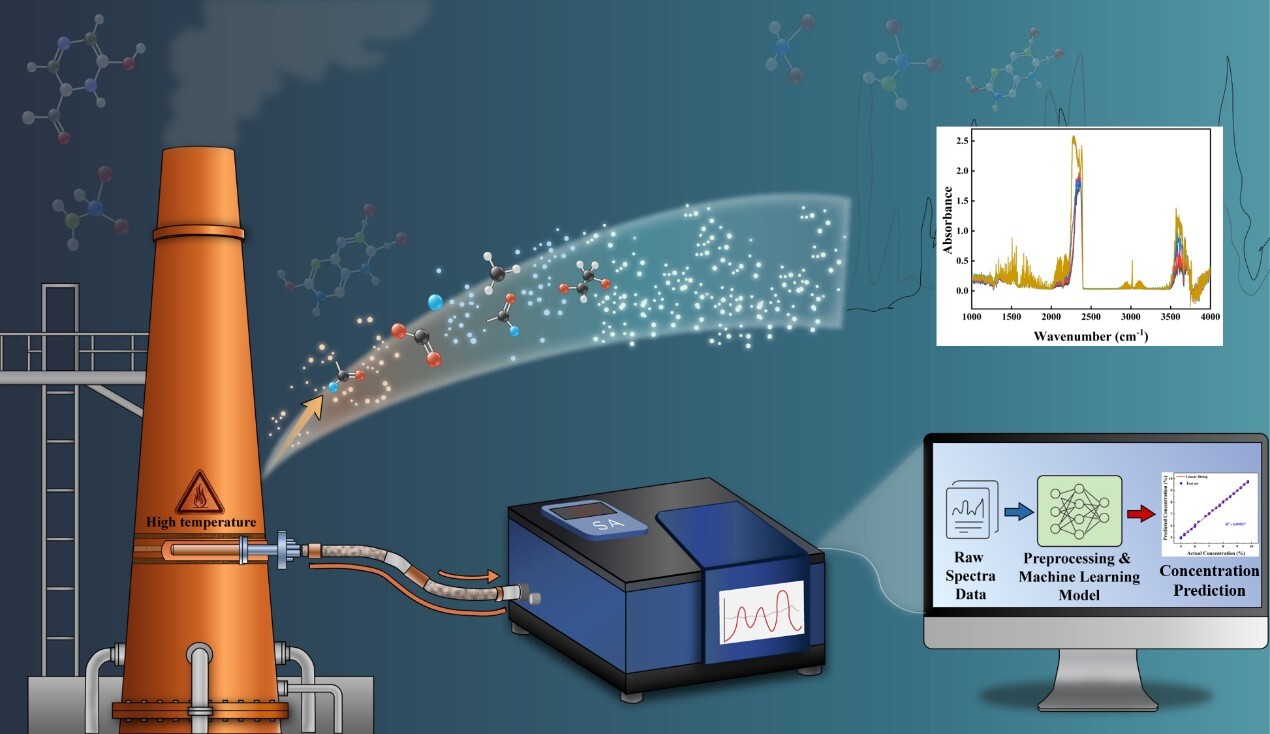
Schematic diagram of the multi-component infrared online monitoring system for industrial flue gas. (Image by LI Xiangxian)