



A research team led by Prof. WANG Zhongzhen from the Anhui Institute of Optics and Fine Mechanics, Hefei Institutes of Physical Science, Chinese Academy of Sciences, in collaboration with researchers from the University of Science and Technology of China and Anhui University, has developed a new membrane-based approach for high-salinity brine treatment.
The study demonstrates the use of thermoresponsive ionic liquids as recoverable draw solutes in osmotically assisted reverse osmosis (OARO), providing new insights into the development of sustainable brine concentration technologies.
The study was published in the Journal of Membrane Science.
High-salinity brines from desalination and industrial processes are challenging to treat due to high osmotic pressure and energy demand. OARO offers a promising approach, but conventional salt-based draw solutions still face challenges in energy-efficient recovery.
In this study, the researchers proposed using thermoresponsive ionic liquids (TRILs) as recoverable draw solutes. These ionic liquids have low volatility and can be regenerated using low-grade heat. The team selected a thermoresponsive ionic liquid, [P4444][DMBS], and developed a laboratory-scale TRIL-based OARO system.
The system achieved stable operation under high-salinity conditions. After treatment, the diluted ionic liquid solution could be regenerated through thermal phase separation, allowing most of the ionic liquid to be recovered and reused. The researchers also demonstrated that nanofiltration membranes could effectively remove residual ionic liquid from the water phase.
The team also analyzed the process using a transport model and energy assessment. The results showed that OARO performance is influenced by several factors, including membrane selectivity, solute leakage, and draw-solution recovery.
They found that, although thermoresponsive ionic liquids performed well in individual steps, the overall TRIL-based OARO process required more energy than a conventional salt-based system under the studied conditions. The additional energy mainly came from the extra separation processes needed for ionic liquid recovery and water purification.
The findings highlight the need for system-level optimization of membrane technologies and provide guidance for developing more efficient OARO systems for sustainable brine treatment.
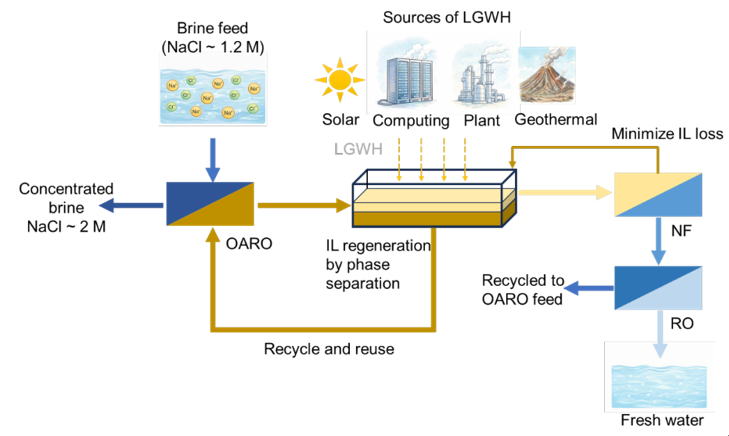
Schematic illustration of the thermoresponsive ionic liquid-based OARO process for high-salinity brine concentration. (Image by WANG Zhongzhen)