



A research team led by Prof. WU Zhengyan and Prof. ZHANG Jia at the Hefei Institutes of Physical Science, Chinese Academy of Sciences, has developed a nanocarrier that helps protect iron from oxidation and keep it on plant leaves after rainfall.
The study has been published in Carbon.
Iron is essential for plants, particularly for photosynthesis and chlorophyll production. However, in alkaline soils, Ferrous Iron (Fe2+) can become poorly soluble and difficult for plant roots to absorb. Applying iron directly to leaves can bypass this problem, but foliar iron treatments face other challenges: Fe²⁺ can be easily oxidized, droplets do not spread well on the waxy surface of leaves, and rain can wash away much of the treatment.
To address these problems, the researchers developed a carbon dot-stabilized and coordination-gated nanocarrier, known as NFCT. The carrier loads Fe2+ and carbon dots into porous silica particles and is covered with a thin coordination layer made from tannic acid and iron.
This structure helps protect the iron during storage and control its release on leaf surfaces. The outer layer also improves spreading and helps the treatment remain on leaves after wetting.
NFCT also improved the stability of Fe2+ during storage. More importantly, after simulated rainfall equivalent to 70.7 mm, NFCT retained 72% of the iron deposited on leaves, compared with 26% for commercial EDTA-Fe.
The treatment also improved iron uptake in Fe-deficient rice, with leaf iron content reaching 160 μg per gram of dry weight, alongside improvements in chlorophyll levels, biomass and fine-root development.
In a single-site, single-season field trial, NFCT and commercial EDTA-Fe showed no statistically significant differences in the agronomic traits measured under the same iron-equivalent application program.
The researchers also found no evident acute adverse effects from the carrier alone in the rice and adult zebrafish tests included in the study.
"The technology shows promise for more effective foliar iron delivery," said Prof. WU, "Further field trials will help us optimize its performance under different conditions."
This research was supported by the National Key R&D Program of China and the National Natural Science Foundation of China.
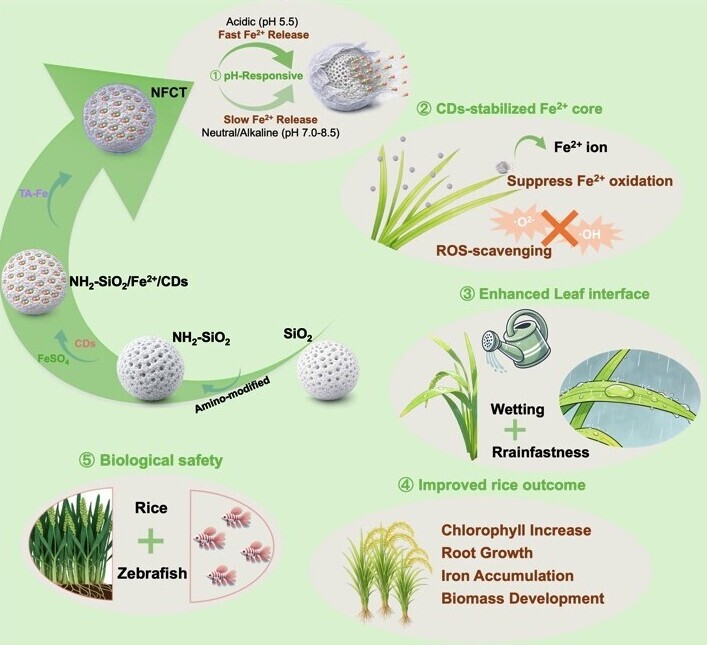
Schematic illustration of NECT construction and rainfast foliar iron delivery. (Image by TENG Guopeng)