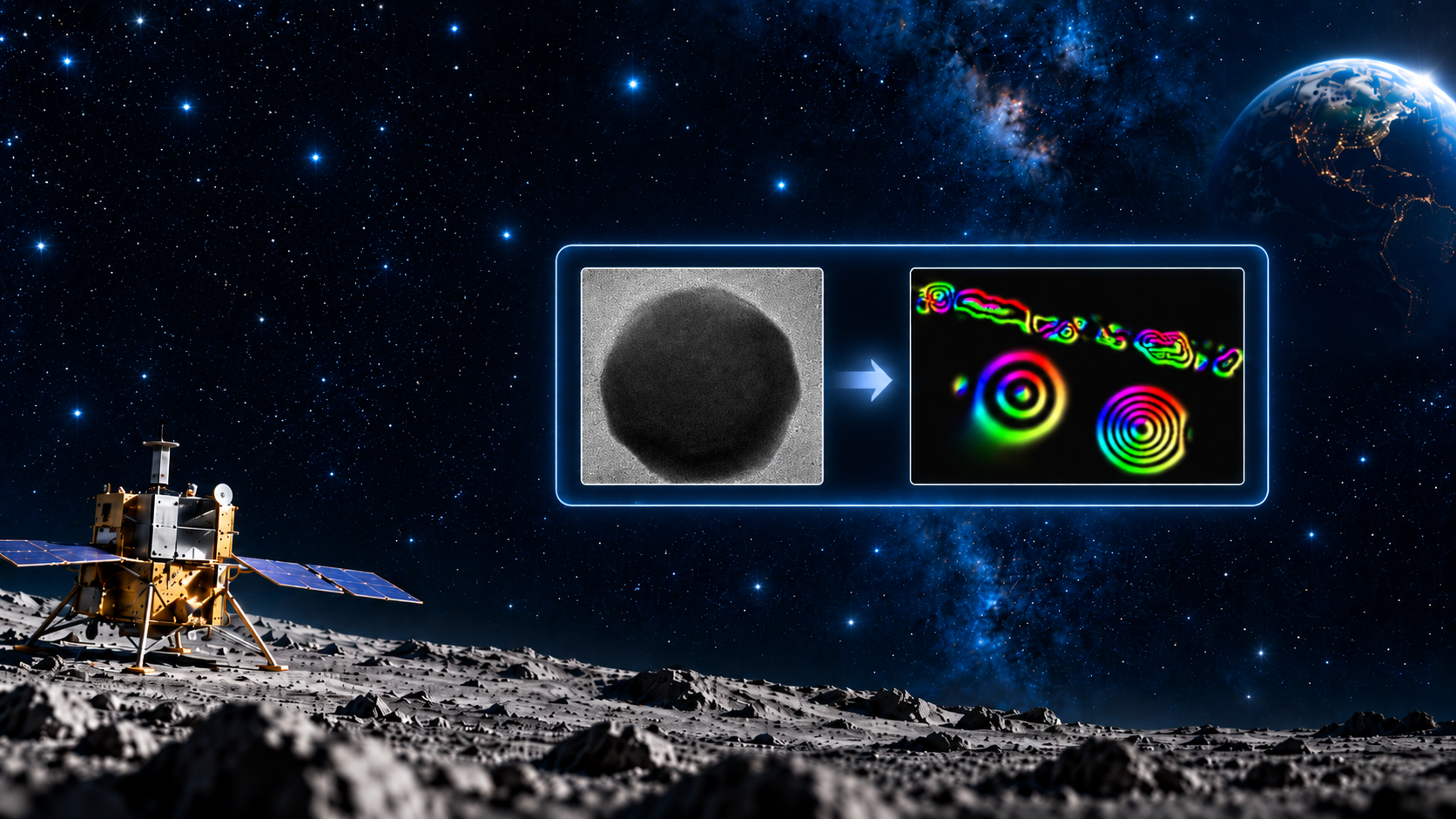
What if a tiny grain of iron could act like a miniature recorder, holding clues to the Moon's ancient magnetic field?
Scientists studying lunar soil from China's Chang'e-6 mission have found a special form of iron that may do just that.
Researchers from the High Magnetic Field Laboratory of the Hefei Institutes of Physical Science, Chinese Academy of Sciences, discovered a form of iron known as γ-Fe in lunar samples. It is the first time this form of iron has been found in natural lunar materials.
Why is that surprising?
Iron comes in different forms. The one the researchers found usually exists only at high temperatures. As it cools, it normally changes into another form, known as α-Fe. Yet the γ-Fe particles survived in tiny glass fragments formed by impacts on the Moon.
How did they manage that?
The researchers think the answer may lie in how lunar impacts melt and cool material. Rapid cooling, small amounts of other elements, and the surrounding glass may have helped preserve the unusual iron structure.
But there's another reason to pay attention to these tiny particles.
The Moon no longer has a global magnetic field, but traces of ancient magnetism can remain in lunar rocks and soil. The team found that some γ-Fe nanoparticles could maintain a stable magnetic state even when exposed to an external magnetic field.
This makes γ-Fe a potential new recorder of magnetic information in lunar materials.
Who knew a tiny grain of iron could have such a long memory? The Moon may have left some of its old secrets hiding in the dust.