



Scientists at the Hefei Institutes of Physical Science, part of the Chinese Academy of Sciences, and Southwest Hospital in Chongqing grew 40 "mini-tumours" (organoids) from 53 samples of triple-negative breast cancer. Their response to drugs matched what happened to the patients, and helped the team see why sacituzumab govitecan fails in many women and how to make it work again. The caveat: this was done in cultures and in mice carrying human tumours; a trial in patients is still needed.
Each one is a tiny ball of cells, grown from a patient' s own tumour. A team from the Chinese Academy of Sciences in Hefei and Southwest Hospital in Chongqing grew 40 of these organoids from 53 samples of triple-negative breast cancer, one of the hardest types to treat because it does not respond to hormone therapies.
According to the study, published on 25 November in Cell Reports Medicine, the way each mini-tumour responded to drugs matched what happened to the patients. The caveat: everything has been tested in cultures and in mice carrying human tumours, and a clinical trial is still needed before it can guide treatment decisions.
Eleven drugs, tested in the lab
The team tested 11 drugs already approved by the US Food and Drug Administration (FDA) on the organoids. The idea is simple: before giving a patient a treatment, check on her own mini-tumour whether it will work.
Why a drug stops working
One of those drugs is sacituzumab govitecan, used for this cancer but not effective in every woman. Comparing the tumours that responded with those that did not, the researchers found that a cell signalling pathway called PI3K-AKT was highly active in the resistant ones.
That pathway already has an approved blocker: alpelisib. In mice carrying resistant human tumours, combining the two drugs slowed the tumours again.
What remains to be tested, now in patients, is whether choosing treatment with their own mini-tumour improves outcomes. (Happy News of the Day / Noticias Felices)
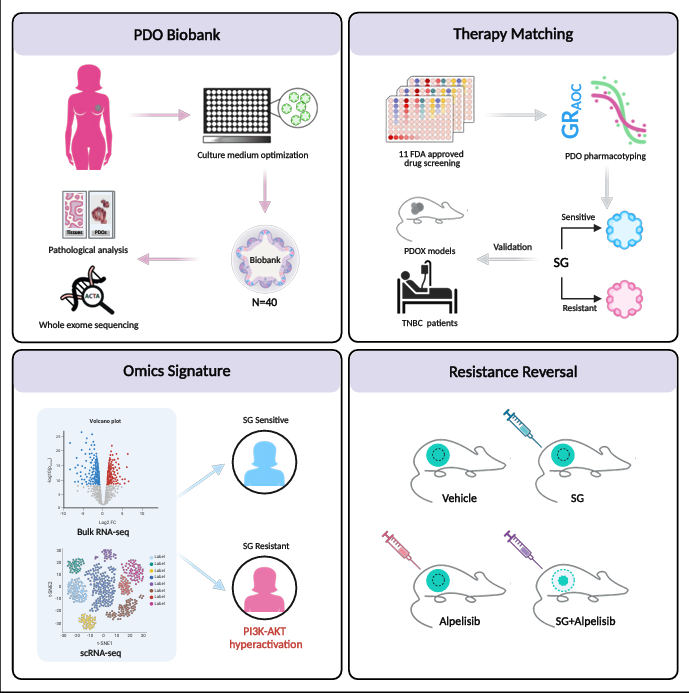
Graphical summary of the study: from the organoid biobank to the combination that reverses resistance in mice. Image courtesy of the Hefei Institutes of Physical Science. Photo: WANG Wenchao / Hefei Institutes of Physical Science, CAS