



A research team from the Hefei Institutes of Physical Science of the Chinese Academy of Sciences, has demonstrated ultrafast and highly reversible all-slope sodium storage using specially engineered hard carbon anodes.
The result was published in ACS Nano.
Sodium-ion batteries are attractive because sodium is abundant and inexpensive. However, their performance is often limited by the anode. Hard carbon is one of the most promising anode materials, but conventional structures suffer from an "interlayer confinement" effect that slows down sodium-ion transport. Attempts to introduce defects and surface sites can improve ion mobility, but too many defects trigger excessive electrolyte decomposition and form a thick solid electrolyte interphase (SEI), reducing the battery' s initial Coulombic efficiency.
In this study, the team developed an amino-nitrogen–guided pore-engineering strategy using a gas-phase-assisted pyrolysis method. During pyrolysis, the dissociation of ammonia generates amino functional groups that selectively react with unsaturated sites in the carbon skeleton. This reaction converts electrochemically irreversible pyrrolic nitrogen into more stable and reversible pyridinic nitrogen. The process also induces the formation of vertically aligned through-pores, helping sodium ions move more freely and relieving the interlayer confinement effect.
The amino groups also contribute to forming an ultrathin SEI layer with a graded chemical composition. In this SEI, fluoride-rich regions beneath the surface improve interfacial ion transport and effectively reduce irreversible sodium loss.
With these structural and interfacial enhancements, the engineered hard carbon anode achieves very high initial efficiency and strong reversible capacity. Even under extremely high current conditions, it still maintains considerable capacity and shows long-term cycling stability over thousands of charge–discharge cycles.
This study offers a promising pathway for boosting the performance of sodium-ion batteries, which is an emerging alternative to lithium-ion technology for large-scale energy storage.
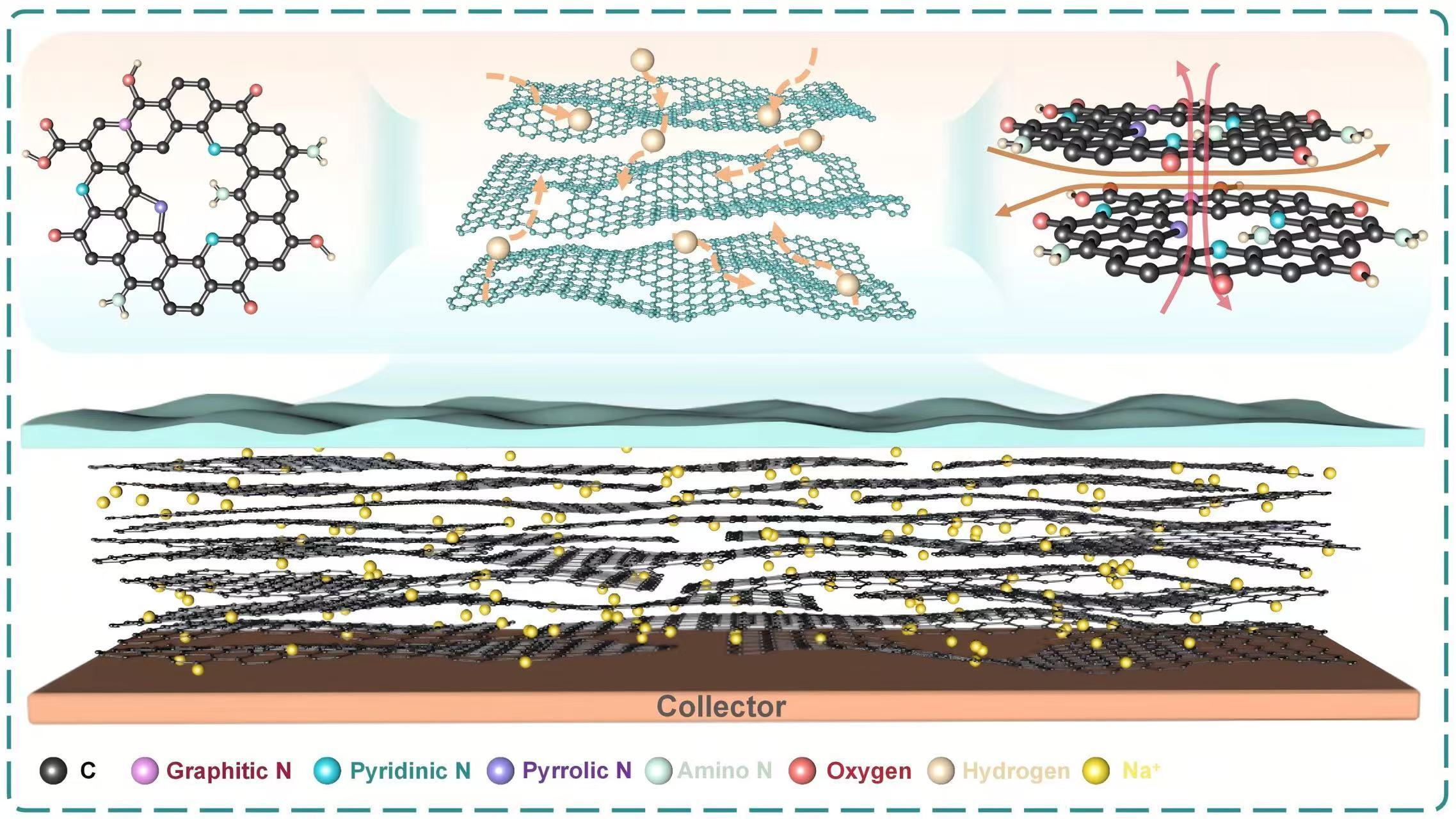
Schematic of through-pore structure in hard carbon for sodium ion batteries (Image by WANG Peiyao)