



A research team from the Hefei Institutes of Physical Science of the Chinese Academy of Sciences has advanced the characterization and retrieval capability evaluation of microphysical properties of Venusian clouds and haze.
The findings were recently published in ICARUS.
Venus' thick cloud and haze layers play a vital role in regulating the planet' s energy balance and atmospheric circulation. Accurately retrieving key microphysical parameters from intensity and polarization observations is essential for current and future Venus exploration missions.
In this study, the researchers built a layered atmospheric model of Venus' clouds and haze and evaluated the sensitivity of intensity and polarization observations to key aerosol parameters. They found that intensity measurements are more responsive to the lower cloud layers, while polarization observations—particularly at small phase angles—provide better constraints on the particle size and refractive index of the upper clouds and haze.
Using the Degrees of Freedom for Signal index, the team showed that combining intensity and polarization measurements significantly increases the amount of retrievable information. Adding near-infrared bands from the VenSpec-H instrument further enhances the retrieval of upper cloud parameters and refractive index.
The study also indicates that intensity and polarization channels should be properly arranged across the 650 nm–2.5 μm aerosol window bands, and that high measurement accuracy is crucial for reducing retrieval uncertainties.
This work provides new insights for studying atmospheric aerosols on Venus and other terrestrial planets, according to the team.
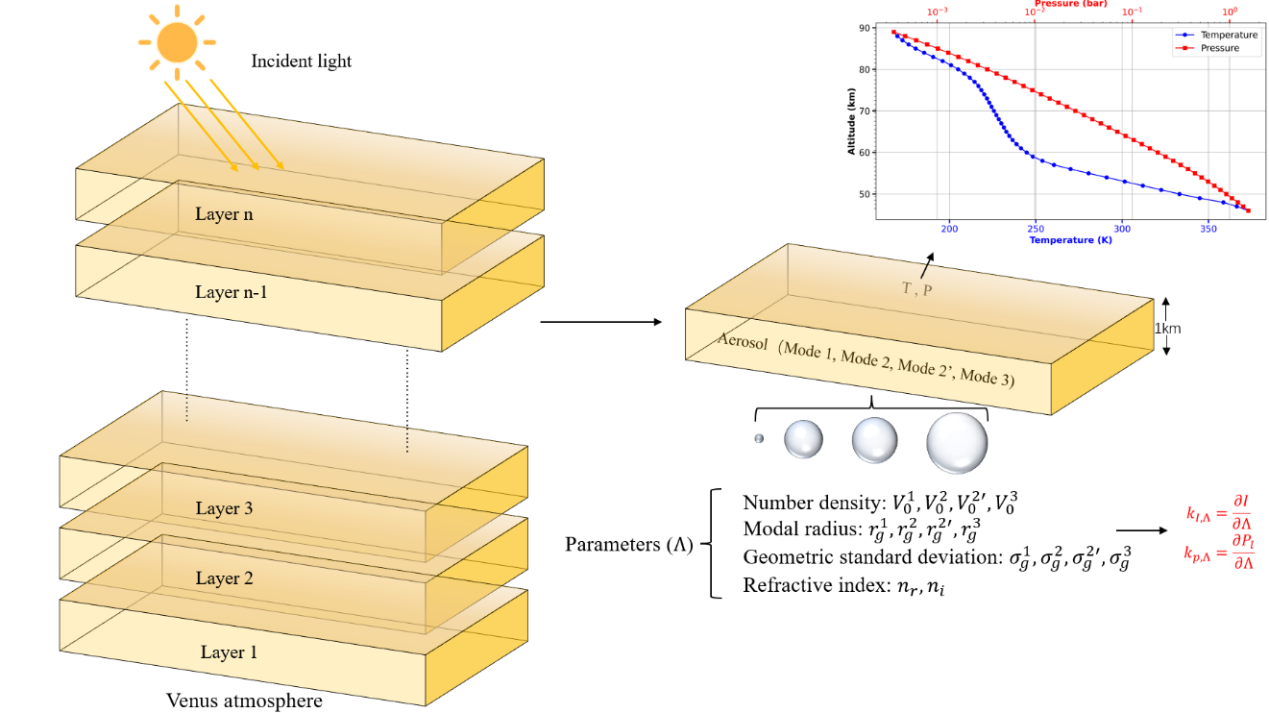
Schematic diagram of layered modeling of Venusian clouds and haze (Image by LI Yiqi)
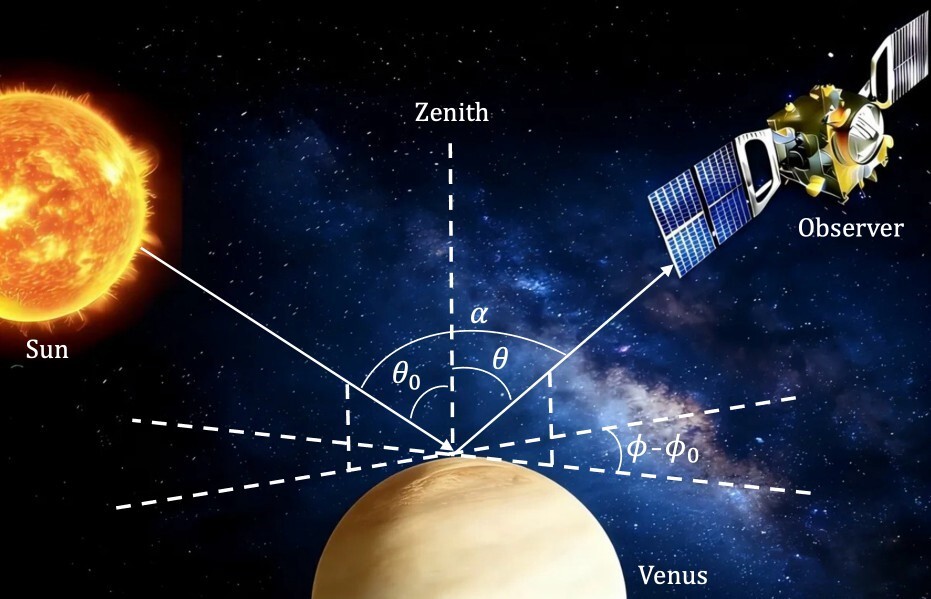
Schematic illustration of the observing geometry for the Venus atmosphere (Image by LI Yiqi)