Recently, a research group led by Prof. SUN Youwen from the Hefei Institutes of Physical Science of the Hefei Institutes of Physical Science of the Chinese Academy of Sciences, along with Prof. YE Minyou from the University of Science and Technology of China, realized a new plasma confinement regime using small 3D magnetic perturbations that simultaneously suppress edge instabilities and enhance core plasma confinement in the Experimental Advanced Superconducting Tokamak (EAST).
These research results were published in PRX Energy.
Achieving sustained high plasma confinement at both the core and the edge, without edge crash events due to edge instabilities, is critical for efficient fusion energy production in tokamaks. However, achieving stable high core confinement with an internal transport barrier (ITB) is extremely challenging, especially in tungsten-wall devices where tungsten impurity accumulation must be controlled. Furthermore, controlling edge instabilities usually results in core plasma confinement degradation.
In this study, researchers applied small 3D magnetic perturbations localized at the plasma edge. This method not only achieved edge instabilities suppression and tungsten impurity control but also, for the first time, enabled high core plasma confinement with an ITB to be induced and sustained. Through in-depth investigations, researchers uncovered the complex physical mechanisms underlying ITB formation, which involves multi-scale, nonlinear interactions among small magnetic perturbations, tungsten impurity, plasma rotation, and current profiles.
Compared to conventional methods, ITB formation using magnetic perturbations is independent of the initial plasma conditions and feature a power threshold reduced by more than half. Further studies have shown that magnetic perturbations can not only sustain ITB stably and effectively but also allow for active control of ITB behavior by adjusting the profiles of the perturbations. Using this method, effective ITB control has been achieved over a broad range of plasma densities and edge safety factor on EAST. This breakthrough demonstrates a method to achieve both stable edges and high-performing cores, which is critical for the efficient operation of future fusion reactors.
This work not only opens a new direction for studying complex nonlinear plasma dynamics under 3D fields in tokamaks, but also establishes a novel approach for investigating, controlling, and optimizing internal transport barriers in future fusion reactors.
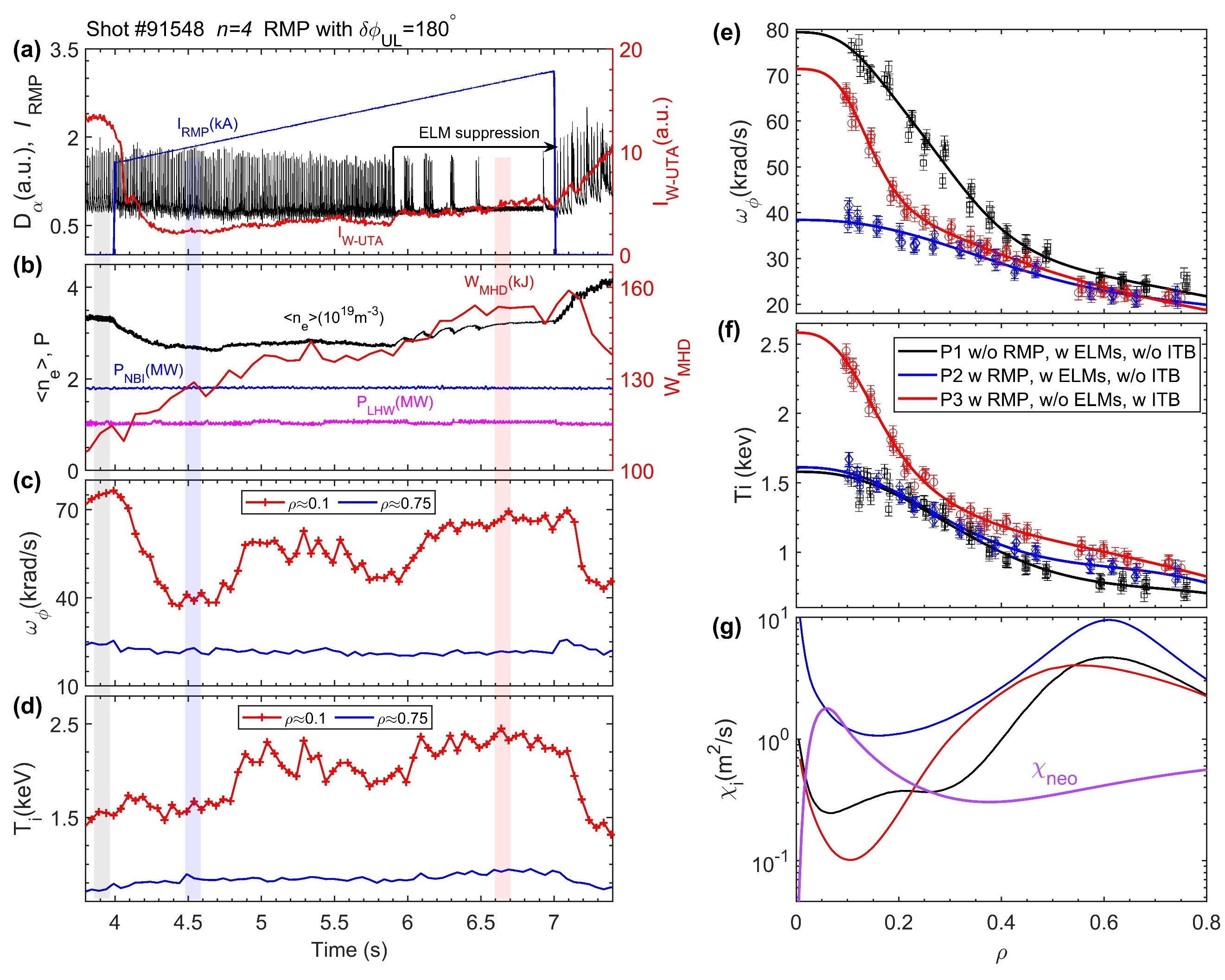
Demonstration of simultaneously achieved formation of ITB and edge instabilities suppression using small 3D magnetic perturbations in EAST. (Image by SHENG Hui)