Recently, Prof. ZOU Liangjian' s group from the Institute of Solid State Physics, Hefei Institutes of Physical Science, Chinese Academy of Sciences, in collaboration with Professor LIU Dayong from Nantong University, has shown that multiple anisotropic magnetic interactions can give rise to a rich variety of topological magnon phases in two-dimensional Kagome ferromagnets, offering a new platform for the development of magnonic devices and potential applications in quantum information technologies.
The findings have been published in Physical Review B.
Magnons, the quantized excitations of spin waves, offer low energy dissipation and efficient transport, making them attractive for low-power spin-based information technologies. Kagome lattices, known for their Dirac points and flat bands, provide an ideal platform for realizing topological magnon states. However, the coexistence of multiple magnetic interactions in two-dimensional Kagome ferromagnets makes it challenging to understand and control their topological properties.
In this study, the research team developed a comprehensive theoretical model that incorporates Heisenberg exchange together with anisotropic interactions, including the Dzyaloshinskii–Moriya interaction (DMI) and the pseudodipolar interaction (PDI). Through systematic analysis of magnon band structures, Berry curvature, and topological invariants, they demonstrated that different anisotropic interactions play distinct roles in regulating topological properties.
Their results show that DMI can generate nontrivial topological magnon phases characterized by moderate Chern numbers, while PDI gives rise to a broader class of topological states with significantly enhanced Chern numbers. When both interactions are present, they exhibit complex competitive and cooperative effects, leading to pronounced band inversions and gap evolution. This interplay drives a series of topological phase transitions and enriches the overall phase diagram.
Notably, the study also predicts temperature-dependent sign reversals in thermal Hall and Nernst responses within certain topological regimes. These effects are linked to changes in band gaps and Berry curvature near magnetic phase transitions, offering a plausible theoretical explanation for previously puzzling experimental observations.
A key contribution of this work is the demonstration that topological magnons can be effectively tuned by multiple anisotropic magnetic interactions. The emergence of high-Chern-number phases and temperature-dependent transport responses opens new possibilities for directional magnon transport and topological control.
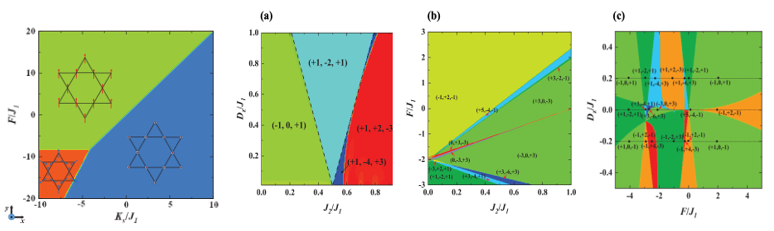
Figure 1. (Left) Ks-F phase diagram of classical ground state with fixed parameters B=0, J1 = 1, J2 =0.5, and Dz = 0.2. (Right) J2/J1-D/J1 topological phase diagram. The topological phases denoted by the Chern numbers of the magnon bands are listed in different color regions.