A research team led by KONG Lingtao from the Institute of Solid State Physics, the Hefei Institutes of Physical Science of the Chinese Academy of Sciences, developed a series of high-performance membranes capable of efficiently degrading emerging contaminants such as antibiotics, and successfully demonstrated their application in pharmaceutical wastewater treatment.
The findings were published in Journal of Hazardous Materials and Chemical Engineering Journal.
In recent years, membrane-based catalytic oxidation technologies have shown great promise for removing emerging pollutants. However, their practical application has been hindered by several challenges, including catalyst leaching, membrane fouling, reduced catalytic efficiency due to blocked active sites, and the difficulty of balancing membrane separation with oxidation kinetics. High material costs and complex fabrication processes have further limited large-scale deployment.
In this study, the researchers utilized the structural tunability of MXene nanosheets and combined them with microfiltration membrane fabrication techniques to design multifunctional Fenton-like catalytic membranes. Using a non-solvent-induced phase separation (NIPS) method, they achieved uniform dispersion and stable anchoring of metal-based catalysts on polyvinylidene fluoride (PVDF) substrates. This strategy suppressed catalyst aggregation, strengthened interfacial adhesion, and significantly improved membrane stability, antifouling performance, and permeation flux.
Based on this approach, the team developed a range of catalytic membranes, including hollow fiber and flat-sheet configurations. When integrated into a coupled system combining Fenton-like oxidation and membrane separation, these membranes enabled efficient removal of antibiotics.
Building on these advances, the researchers further developed an integrated treatment process combining a membrane bioreactor (MBR) and a catalytic membrane reactor. This system was successfully applied to real pharmaceutical wastewater, achieving efficient removal of antibiotics, total organic carbon, suspended solids, and ammonia nitrogen (NH₄⁺-N).
"This process cut treatment costs by more than 30%," said Dr. XIE Chao, a member of the team. "It shows strong technical performance while also delivering clear economic benefits."
This work provides a promising new solution for the treatment of high-COD refractory industrial wastewater and highlights the significant potential of catalytic membrane technologies for large-scale environmental applications.
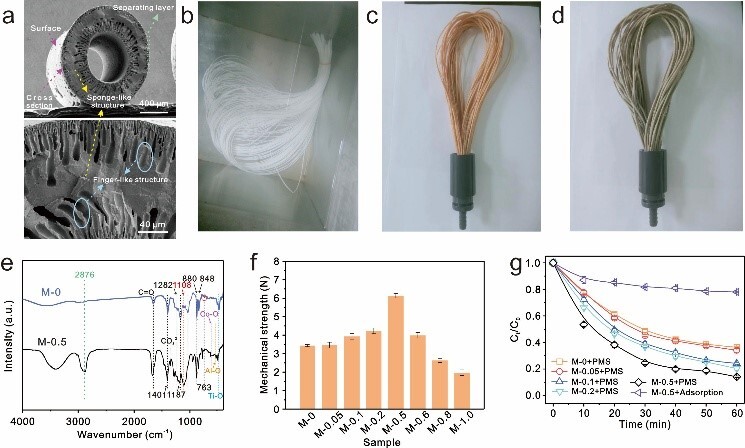
CoAl-LDH/Ti3C2Tx@PVDF hollow fiber catalytic membrane and properties. (Image by XIE Chao)