



A research team led by Prof. YIN Huajie from the Institute of Solid State Physics, Hefei Institutes of Physical Science, Chinese Academy of Sciences, has developed a high-performance chlor-alkali electrode catalyst that combines outstanding activity with long-term stability.
The study was published in Nature Communications.
Efficient and durable catalysts for the chlorine evolution reaction (CER) are critical for chlor-alkali and related brine electrolysis processes, but conventional anodic materials often struggle to balance catalytic activity, selectivity, cost, and stability under harsh operating conditions.
To address these challenges, the team carried out systematic investigations into catalyst design, active-site regulation, and reaction mechanisms. Building on this approach, they developed a new catalyst by introducing atomically dispersed cerium (Ce) into spinel Co3O4 with a three-dimensionally ordered macroporous structure 3D Ce–Co3O4.
Structural characterization revealed that Ce atoms occupy octahedral Co sites, inducing local structural distortion and generating undercoordinated Co active centers capable of directly adsorbing Cl- ions. Further in situ characterization and density functional theory calculations showed that Ce doping shifts the active site from an oxygen-centered to a Co-centered configuration, optimizing Cl- adsorption, enhancing catalytic activity, and effectively suppressing lattice-oxygen corrosion.
Electrochemical tests demonstrated that in acidic NaCl electrolyte, the catalyst delivers excellent performance, requiring only a very low overpotential to drive the chlorine evolution reaction with near-perfect selectivity. Under conditions simulating industrial chlor-alkali electrolysis, it maintained stable operation for an extended period at a high industrial-level current density.
These results highlight the strong potential of 3D Ce–Co3O4 for chlor-alkali electrolysis, offering a promising strategy for developing efficient and durable non-noble-metal CER catalysts.
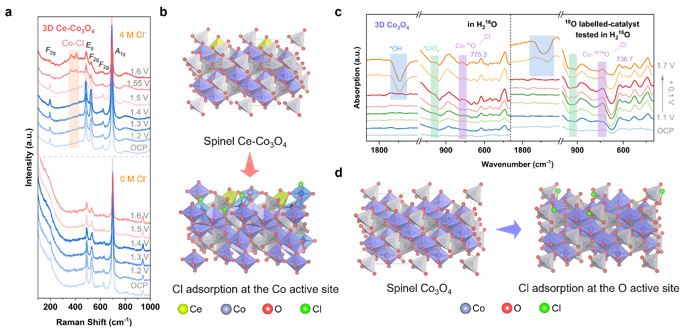
Schematic illustration of active-site transformation in the 3D Ce-Co3O4 catalyst (Image by YIN Huajie)