



Recently, a research team led by Prof. GAO Xiaoming and LIU Kun from the Hefei Institutes of Physical Science of the Chinese Academy of Sciences, developed a cascaded neural network for analyzing mixed microplastic Raman spectra.
Their findings were recently published in Analytical Chemistry.
Microplastics, which are smaller than 5 mm, are widespread and pose growing environmental and health concerns. Raman spectroscopy combined with neural networks offers a promising solution for their identification, but accuracy is often limited by overlapping signals in complex samples and low quality data collected in real world environments.
The cascaded neural network framework in this study consists of three key components: a channel and spatial attention module for enhanced feature extraction, a reconstruction and classification module for robust spectral analysis, and a hybrid physical loss function to guide training and improve model convergence. Together, these components enable the framework to efficiently reconstruct spectra, classify different microplastic types, and separate overlapping signals, even under challenging measurement conditions.
Testing on 20–25 mixed microplastic samples collected under varying conditions showed remarkable improvements. Under low laser power (~50 mW) and short integration time (~3 seconds), classification accuracy increased from 52% using conventional methods to 91% with the new framework.
This work provides a promising solution for accurate microplastic identification in complex and low-quality measurement environments, supporting more reliable environmental monitoring and research.
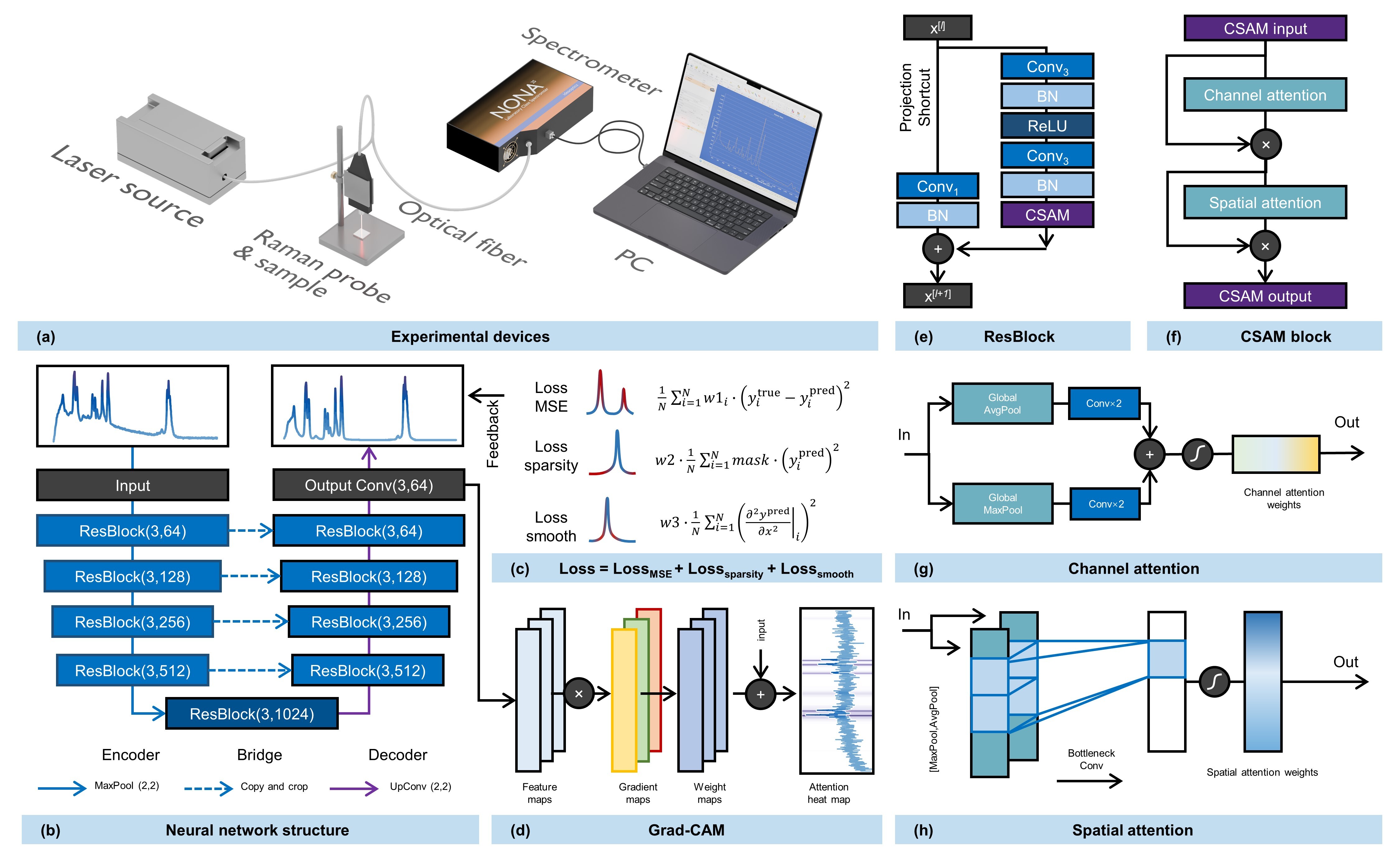
The Raman spectra of detected microplastics are input into a neural network trained to output clean Raman spectra. Spatial and channel attention modules enhance the model' s performance. Training is optimized using a custom loss function. Grad-CAM visualizations highlight the regions of the spectra that the neural network identifies as significant. (Image by HUANG Weixiang)