Recently, a research group led by Prof. SHENG Zhigao from the High Magnetic Field Laboratory (HMFL), Hefei Institutes of Physical Science, Chinese Academy of Sciences, reported the direct observation of strong spin-phonon coupling in the absence of long-range magnetic order.
The research results were published in Physical Review B.
Understanding the interplay between spin states and lattice dynamics is crucial for developing next-generation spintronic devices. However, directly probing spin-phonon coupling in frustrated magnetic systems remains a major challenge due to the lack of long-range magnetic order.
In this study, researchers focused on NaCrO2, a typical two-dimensional layered triangular frustrated antiferromagnet with spin S=3/2. They conducted in-depth research by utilizing the Steady High Magnetic Field Facility (SHMFF) and a temperature-dependent terahertz time-domain spectroscopy system.
Taking advantage of the low-frequency detection sensitivity of terahertz waves, the study tracked temperature-dependent terahertz absorption spectra to sensitively capture the subtle phonon changes induced by spin-phonon coupling under short-range magnetic order.
The results revealed that short-range spin correlations in NaCrO2 persist well above the magnetic phase transition temperature. Near the critical point, these correlations give rise to strong spin-phonon coupling, leading to abrupt changes in the frequency and intensity of low-frequency phonons. This effect is attributed to the renormalization of Cr–O bonds and results in an anomalous enhancement of infrared-active phonon modes.
"Our findings revealed the spin-phonon coupling under short-range magnetic order in frustrated magnetic materials, laying a solid physical foundation for developing next-generation spintronic devices," said Prof. SHENG Zhigao.
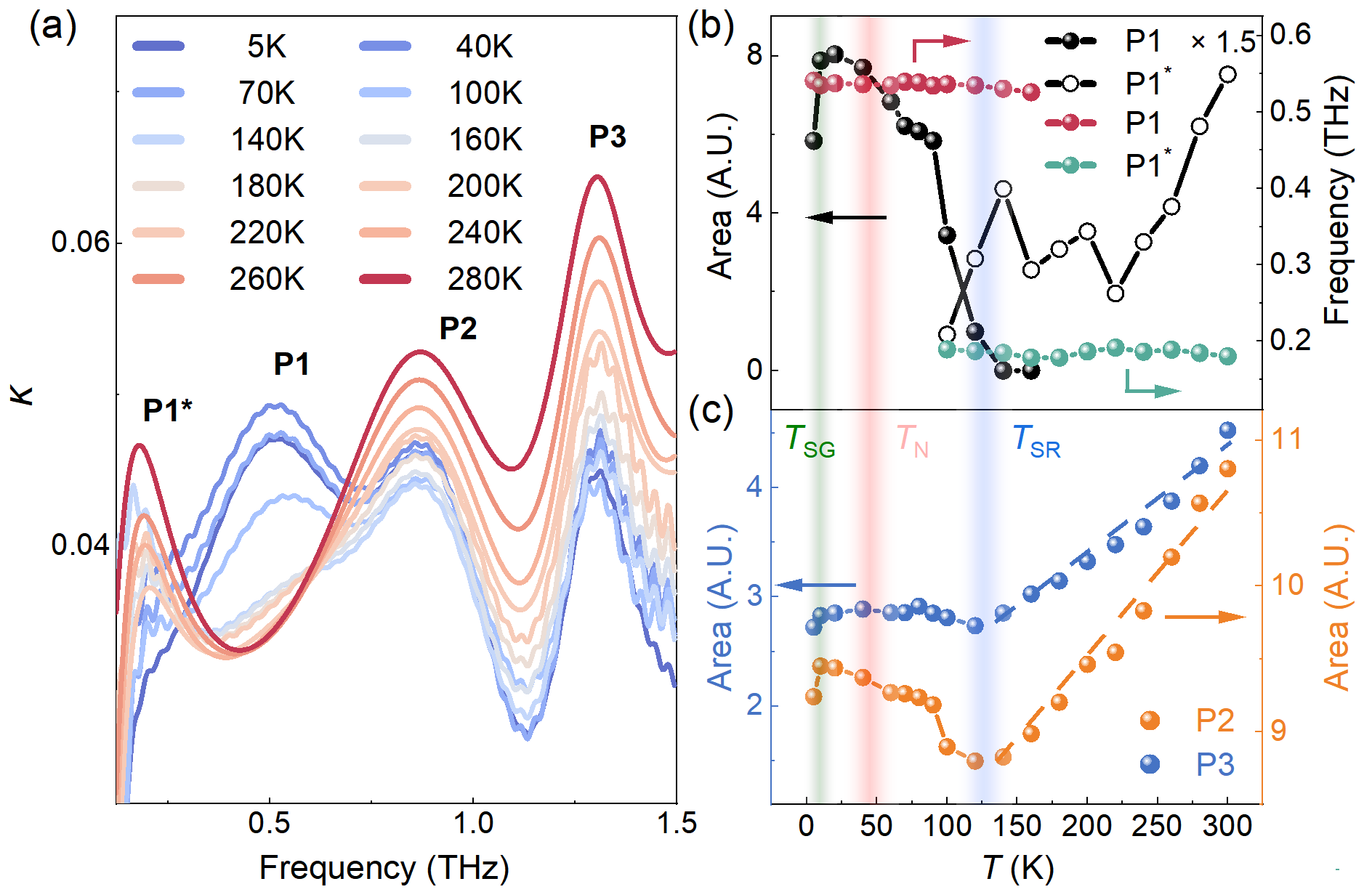
Temperature dependence of phonon frequency and intensity (Image by HUANG Biwen)