A research team led by Researcher CHEN Chong from the Institute of Solid State Physics, Hefei Institutes of Physical Science, Chinese Academy of Sciences, has developed a new synergistic strategy based on glutathione (GSH) additives, combining "dynamic regulation" and "static protection" to improve both the efficiency and stability of inverted perovskite solar cells.
The study was published in Advanced Materials.
Inverted perovskite solar cells based on self-assembled monolayers have shown high efficiency and low cost, but their stability remains a major challenge. Exposure to heat, humidity, and ultraviolet light can degrade the device interface, leading to performance loss and limiting practical applications.
In this study, the researchers introduced GSH as a multifunctional additive to regulate interfacial properties and improve film quality. This approach enhances charge transport, reduces energy loss, and suppresses defect-related recombination, while also strengthening structural stability. In addition, the incorporation of chemical protection and redox self-healing mechanisms helps mitigate environmental degradation and prolong device lifetime.
As a result, the optimized devices achieved a power conversion efficiency of 26.17%, with improved charge carrier extraction and reduced non-radiative recombination losses. Mini-modules (12.50 cm2) reached an efficiency of 23.14%, demonstrating competitive performance at this scale. The devices also exhibited enhanced operational stability, maintaining strong performance under conditions such as high temperature, humidity, continuous illumination, and ultraviolet exposure.
This work provides an effective strategy to overcome the long-standing trade-off between efficiency and stability in perovskite solar cells, offering new opportunities for their practical and large-scale application.
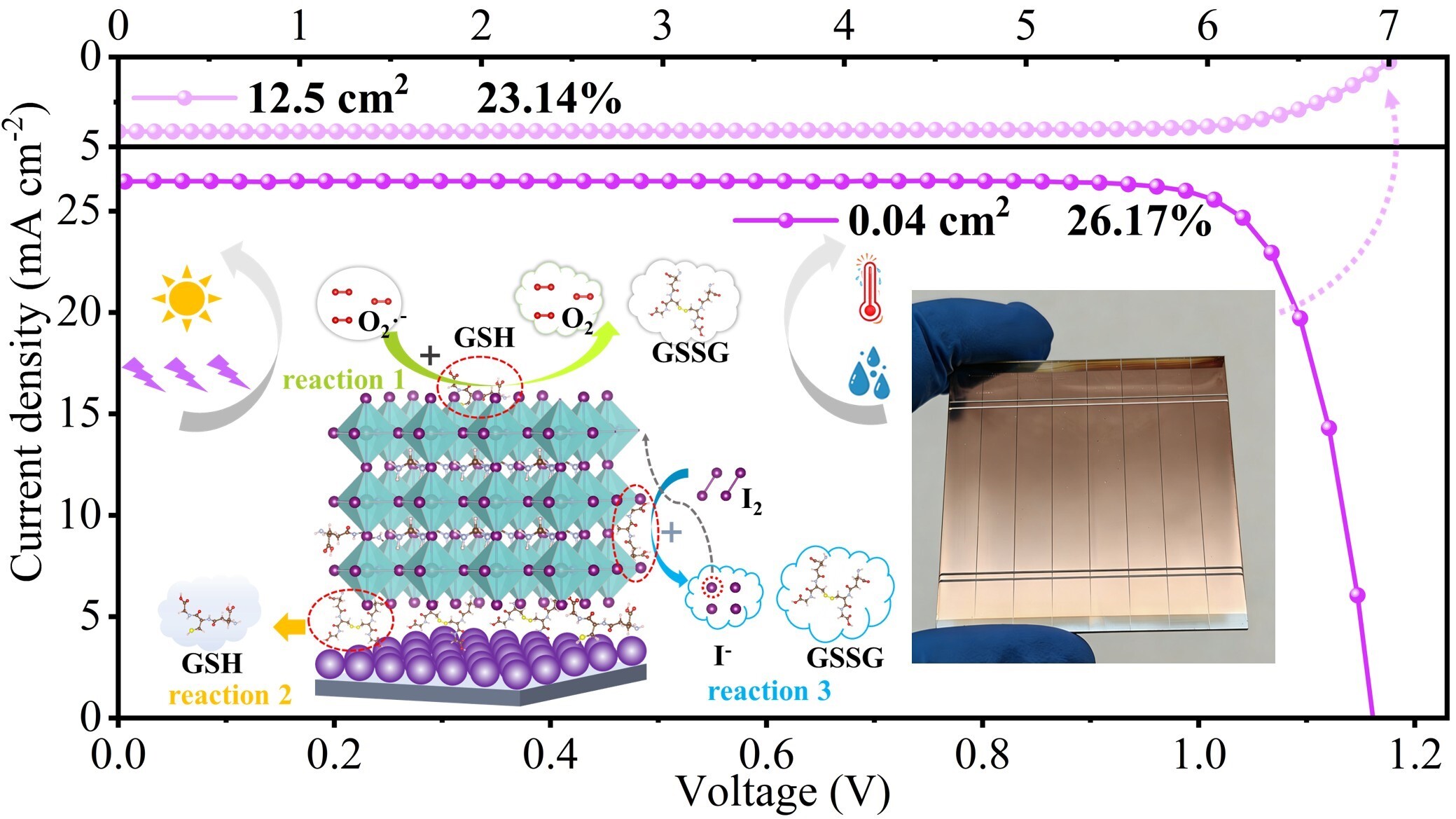
Schematic diagram of the power conversion efficiency of small-area solar cells and mini-modules, as well as the redox-driven self-healing mechanism. (Image by JIN Mengqi)