



A research team led by GUI Huaqiao from the Hefei Institutes of Physical Science of the Chinese Academy of Sciences, in collaboration with the First Affiliated Hospital of Anhui Medical University and Hefei First People's Hospital, has developed a universal semi-supervised AI learning framework. The framework is designed to reduce the burden of manual annotation in three-dimensional (3D) medical image segmentation while improving model generalization across multiple clinical centers.
It supports three key learning settings: semi-supervised learning (SSL), unsupervised domain adaptation (UDA), and semi-supervised domain generalization (Semi-DG), making it adaptable to a wide range of real-world medical scenarios.
The findings were published in Pattern Recognition.
Manual annotation for 3D medical image segmentation is time-consuming and depends on expert knowledge. SSL helps reduce labeling work, but most methods assume the data come from the same source. In real clinical settings, however, images from different hospitals and devices often vary greatly, making SSL, UDA, and Semi-DG harder to apply. Models may also over-rely on simple frequency features, which can hurt generalization and reinforce pseudo-label errors.
The strategy proposed in this study suppressed frequency shortcuts by combining adversarial training with two new data augmentation modules. The Low-frequency Adversarial Adaptive Enhancement (L-AAE) module reduced the model' s reliance on dominant low-frequency features and narrowed distribution differences between images from different centers through adversarial adjustment and style optimization. The Frequency Adaptive Suppression and Enhancement (F-ASE) module adjusted feature weights across frequency bands, helping the model learn richer frequency information and avoid biased features. The original images and optimized adversarial samples were then used together for model training in the SSL framework.
Experiments on several public datasets show that the method performs well across semi-supervised learning (SSL), unsupervised domain adaptation (UDA), and semi-supervised domain generalization (Semi-DG), with improved accuracy and better suitability for real-world clinical applications.
"By reducing the model' s reliance on simple shortcuts in the data, the framework makes predictions more stable and improves segmentation accuracy," explained Prof. GUI.
In addition, L-AAE and F-ASE can be easily integrated into many common neural network models, making the method flexible and practical for different systems.
This work offers a practical solution for improving AI reliability in medical image analysis, especially in real clinical settings with data variations across hospitals.
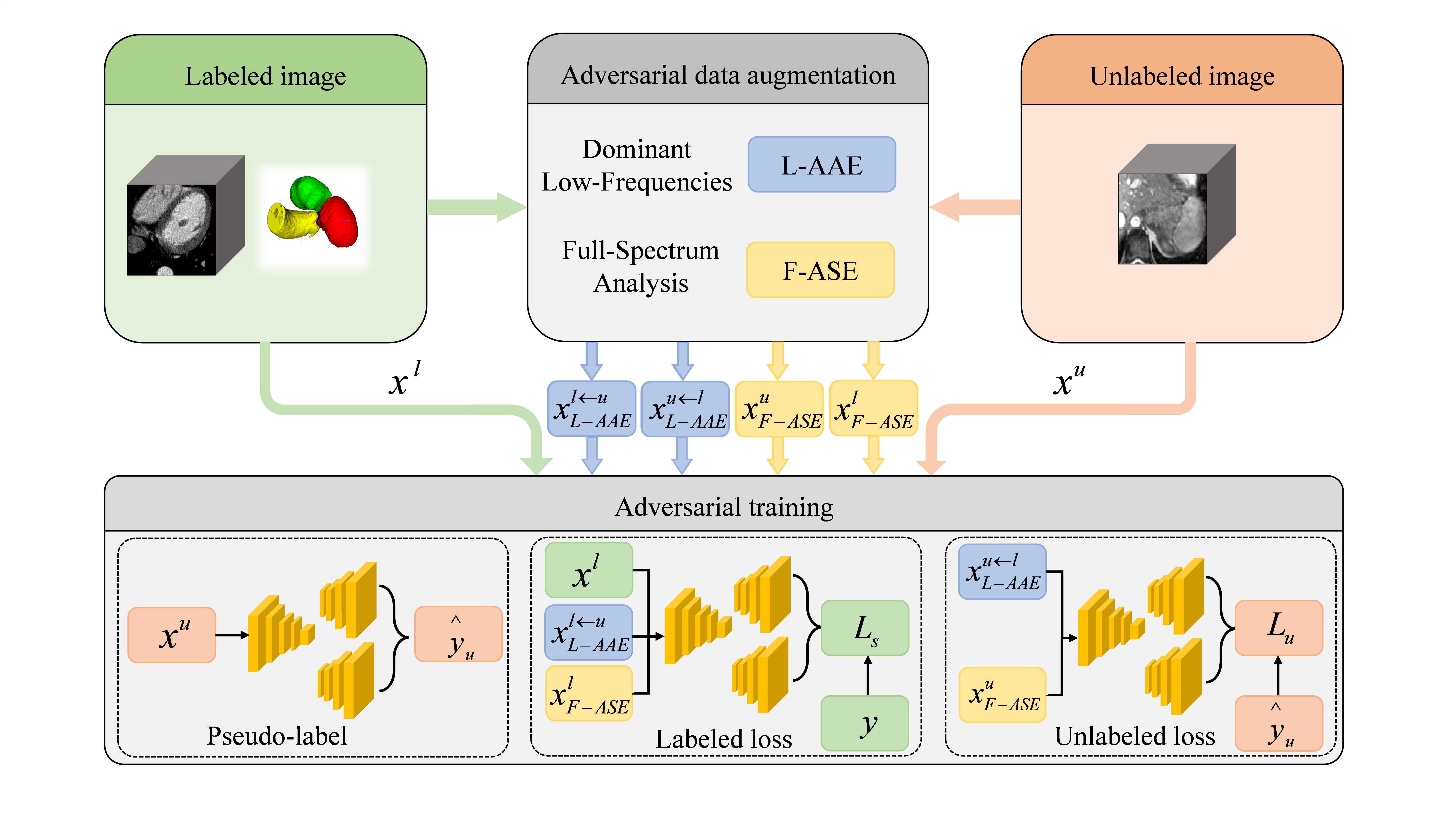
Schematic illustration of a generic semi-supervised learning framework (Image by GUI Huaqiao)