



Recently, a research team led by Prof. ZHU Kunpeng from the Institute of Intelligent Machines, Hefei Institutes of Physical Science, Chinese Academy of Sciences, developed a physics-guided deep learning framework for milling dynamics prediction. The framework enables simultaneous prediction of instantaneous milling forces and spindle vibrations under varying cutting conditions.
The study was published in Engineering.
Milling is one of the most widely used machining processes in precision manufacturing. Accurate prediction of milling forces helps optimize machining parameters, reduce tool wear and vibration, and improve production efficiency and product quality. However, existing prediction methods often face a trade-off between accuracy, adaptability, and interpretability.
To overcome these limitations, the researchers combined physical knowledge of milling dynamics with deep learning techniques.
They first used a dynamics model to generate simulation data for network training, then introduced vibration equations as physical constraints during the learning process. Finally, experimental data from real milling operations were used to further improve the model's performance under practical machining conditions.
Tests showed that the framework accurately predicted both milling forces and spindle vibrations, with an average prediction error of only 2.67%. Compared with conventional data-driven approaches, prediction accuracy improved by 24.44%.
According to the researchers, the framework provides a new approach for dynamic prediction and process optimization in high-speed milling. The framework could also be applied to other machining processes, such as turning and drilling.
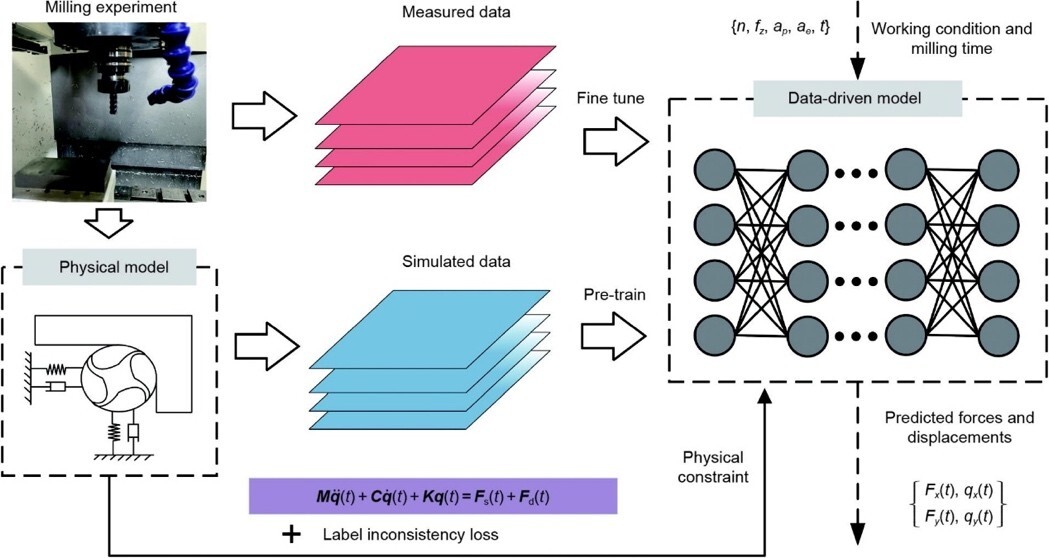
Architecture of the physics-guided deep network model for the milling process. (Image by LI Jun)