



A research team led by Professor JIANG Changlong from the Institute of Solid State Physics, Hefei Institutes of Physical Science of the Chinese Academy of Sciences, has developed a copper-doped cobalt aluminum layered double oxide (CoAlCu-LDO) nanozyme with a two-dimensional (2D) hexagonal ultrathin nanosheet structure, enabling highly sensitive detection of multiple biomarkers in sweat.
The study was published in Biosensors and Bioelectronics.
Natural enzymes are widely used in biosensing and disease diagnosis but suffer from poor stability, high purification costs, and limited reusability. Nanozymes offer a promising alternative due to high stability, low cost, and scalable production. However, most nanozymes still face challenges of low catalytic efficiency and limited substrate affinity, restricting their performance in cascade detection.
To overcome these limitations, the team developed a trimetallic CoAlCu layered oxide nanozyme with an ultrathin 2D hexagonal nanosheet structure. The design exposes more catalytic sites and enhances interactions among the metal components, leading to much higher catalytic activity. As a result, the nanozyme achieves efficiencies dozens of times greater than those of natural enzymes.
Building on this advance, the team developed a colorimetric sensing system for cholesterol, uric acid, and glucose detection. The technology was integrated into a sponge-based wearable device that could analyze sweat within 10 minutes. Coupled with smartphone imaging and AI-powered analysis, it was further transformed into a wristwatch capable of tracking multiple biomarkers simultaneously during exercise.
"It' s like giving a wristwatch the ability to read your sweat," said Prof. Jiang, "By tracking multiple biomarkers in real time, it provides a convenient and noninvasive way to monitor physiological conditions."
This work provides a new structural paradigm for designing high-performance nanozymes and expands their applications in precision healthcare, wearable biosensors, and noninvasive medical monitoring.
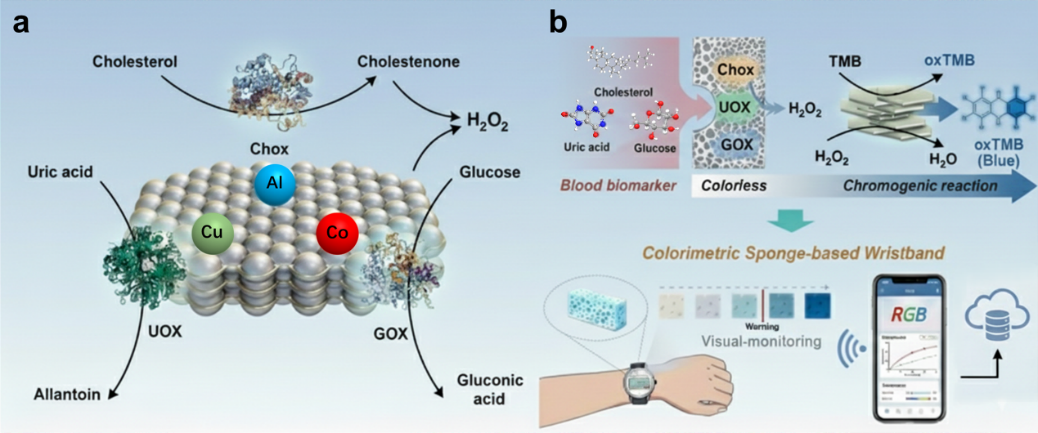
Structural design of the enzyme-nanoenzyme cascade system and its practical applications. (Image by LIN Dan)