A research team led by Prof. WANG Xianlong and Dr. WANG Pei from the Institute of Solid State Physics, Hefei Institutes of Physical Science, Chinese Academy of Sciences, has successfully stabilized a B31-type MnSe0.5Te0.5 phase that exhibits superconductivity driven by pressure-induced Jahn–Teller distortions.
The work has been published in Advanced Materials.
In most manganese-based chalcogenides, superconductivity only appears under high pressure and disappears once the pressure is released, because the key orthorhombic B31 structure is not stable at ambient conditions.
In this study, the team partially replaced selenium with tellurium in MnSe. This substitution increases the energy barrier for the reverse structural transition during decompression, effectively "locking in" the high-pressure B31 phase.
As a result, superconductivity emerges at around 16 GPa during compression and can still be observed down to about 4 GPa during pressure release. In this pressure range, weak antiferromagnetic correlations also reappear and coexist with superconductivity. The unusual path-dependent behavior is believed to be linked to disorder-related quantum critical fluctuations rather than conventional spin fluctuations.
The researchers attribute the emergence of superconductivity to pressure-induced Jahn–Teller distortions, which trigger a Peierls-like Mn–Mn dimerization. This structural change acts as a key ingredient for superconductivity by reshaping the electronic structure and enabling Cooper pair formation. At the same time, it helps stabilize the high-pressure phase over a wider pressure range.
This work demonstrates a chemical strategy to stabilize high-pressure superconducting phases at lower pressures and suggests a possible route to retaining metastable states under ambient conditions for future applications.
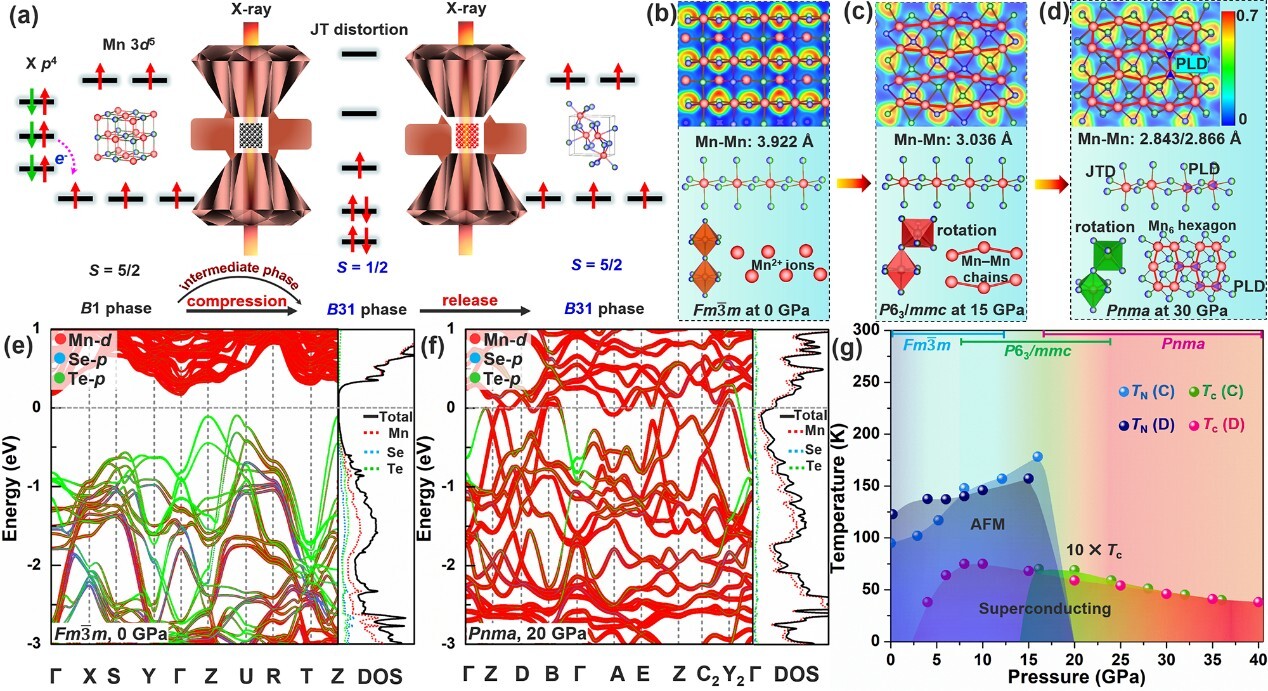
Cooperative structural distortion, band structures, and pressure‑dependent transport and superconductivity in MnSe0.5Te0.5 during compression and decompression. (Image by WANG Pei)