A research team led by Professor ZHANG Na from the High Magnetic Field Laboratory, Hefei Institutes of Physical Science, Chinese Academy of Sciences, has determined the first atomic-resolution structure of an RNA–DNA hybrid G-quadruplex (RDQ) formed between human telomeric DNA and a TERRA RNA fragment.
The study was published in the Journal of the American Chemical Society.
G-quadruplexes (GQs) are special structures formed by guanine-rich DNA or RNA sequences. They are involved in important cellular processes. RNA–DNA hybrid G-quadruplexes (RDQs), which are formed between RNA and DNA strands, have attracted increasing attention because they may play important roles in genome stability and regulation. However, due to the lack of high-resolution structural information, their biological functions have remained poorly understood.
In this study, the researchers used solution nuclear magnetic resonance (NMR) spectroscopy to determine the detailed structure of an RDQ formed by a three-repeat human telomeric DNA sequence and a short fragment of telomeric repeat-containing RNA (TERRA). The structure revealed that DNA and RNA strands can assemble into a unique arrangement, with both parallel and antiparallel strand orientations.
The researchers also discovered that one RNA guanine residue in the RDQ adopts an unusual structural state that is rarely observed in RNA G-quadruplexes. This finding shows that RNA molecules can adjust their structures when interacting with DNA, expanding the understanding of how RNA–DNA hybrid structures form.
Further experiments showed that RDQ formation can protect both DNA and RNA strands from degradation. The team also found that longer RNA molecules and their shorter fragments can work together to promote the separation of matching DNA strands, suggesting that RDQs may participate in regulating interactions between RNA and DNA in cells.
The findings improve the understanding of RDQs and their possible roles in protecting telomeres and maintaining genome stability.
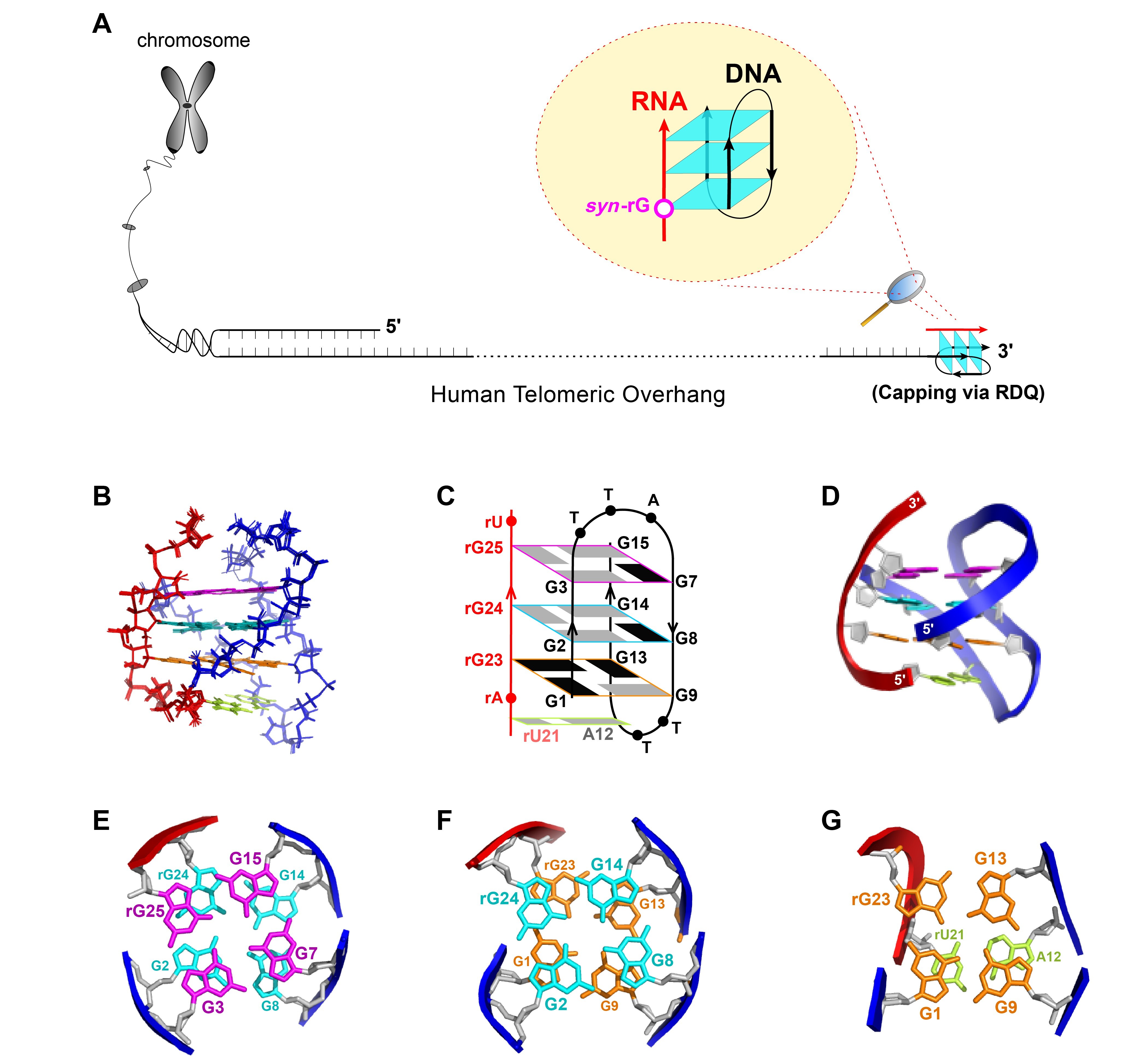
Schematic illustration showing the assembly of the RDQ and its capping/protective function at telomeric overhangs. (Image by FU Wenqiang)