



A research team led by Assoc. Prof. CAO Liang from the Hefei Institutes of Physical Science, Chinese Academy of Sciences, in collaboration with researchers from the Institute of Solid State Physics, Anhui University and other research institutions, has developed a new approach based on controlled interlayer sliding to regulate quantum states in layered materials. By precisely tuning the movement of atomic layers, the approach enables the design of superlattices and the regulation of electronic properties through structural engineering.
The studies were conducted using the Steady High Magnetic Field Facility and were published in Nature Communications and National Science Review.
Van der Waals materials consist of strongly bonded atomic layers with weak interactions between layers, allowing the layers to slide against each other. This unique feature provides a way to modify material structures and electronic properties. TaS2 is a typical quantum material that exhibits various electronic phases, including charge-density waves, Mott insulating states, and superconductivity. However, controlling these states through structural methods remains challenging.
Building on their previous work, the team created periodic superlattice structures in bulk 1T-TaS2 crystals by tuning the arrangement between atomic layers. They found that adjusting the stacking configuration could switch the insulating state between different electronic phases, providing new insight into the origin of the insulating behavior in 1T-TaS2.
They further found that layer sliding combined with atomic rearrangement can trigger structural transformations between different phases of TaS2. The resulting heterophase superlattices contained different electronic phases arranged in a controlled manner and exhibited distinct superconducting states, demonstrating the important role of stacking configuration in determining quantum properties.
Based on these findings, the team proposed that stacking sequences could serve as a structural "code" for designing material properties. By controlling atomic layer arrangements, researchers can tune superlattice structures and electronic behaviors.
The findings establish interlayer sliding as a tool for designing quantum materials and may contribute to the development of layered-material-based quantum devices.
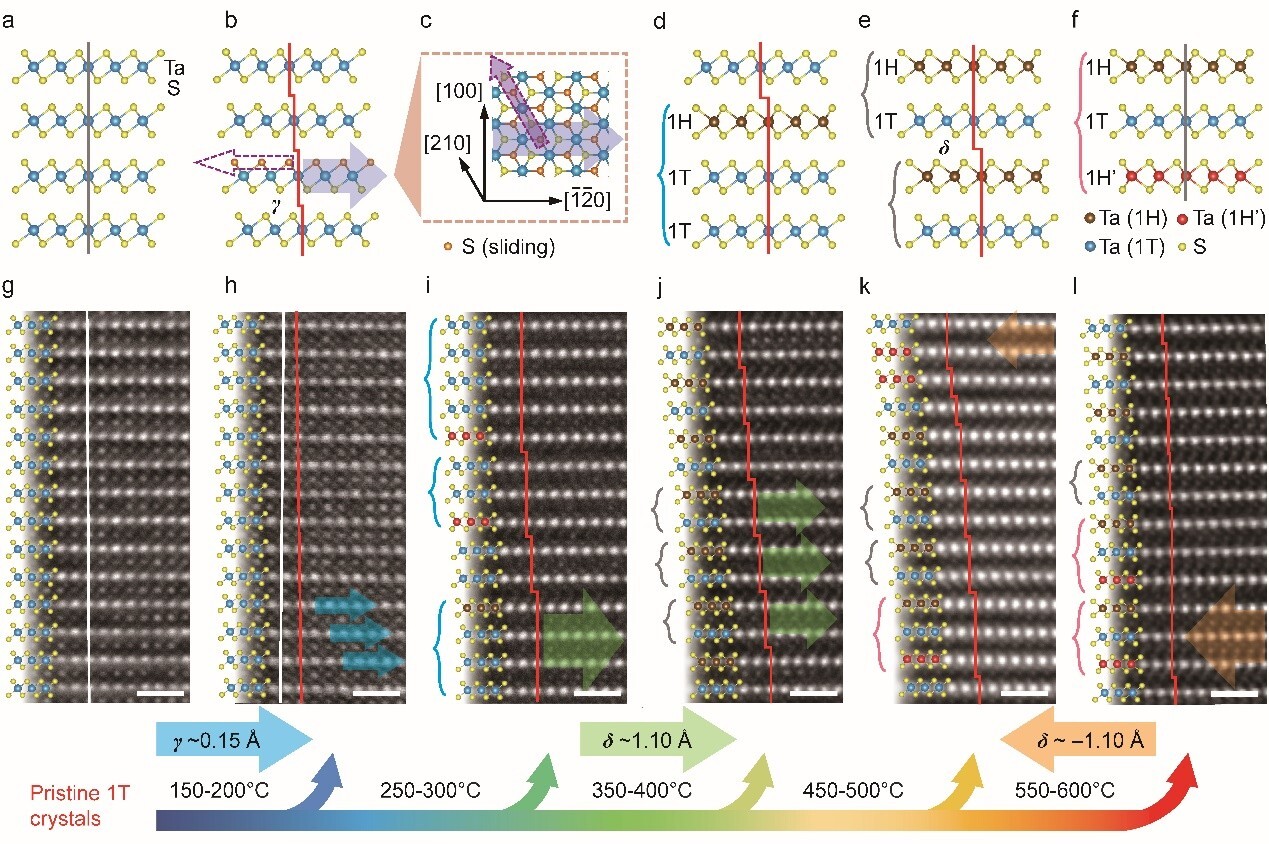
Schematic illustrations of programmable superlattices (Image by CAO Liang)