



A research team led by Researcher WANG Peng from the Hefei Institutes of Physical Science of the Chinese Academy of Sciences, in collaboration with international partners, has developed a new genetic strategy to improve the reliability and efficiency of gene expression in Corynebacterium glutamicum, an important industrial microorganism.
The study was published in the Journal of Agricultural and Food Chemistry.
Corynebacterium glutamicum is widely used in biotechnology to produce amino acids, proteins, and other valuable biological products. However, genetic systems in this bacterium often show different performance depending on the surrounding DNA sequences, making it difficult to achieve precise and predictable gene expression.
To address this challenge, the researchers developed a strategy called “5′-end translationalization.” Instead of treating the 5′ untranslated region (5′UTR) as only a regulatory sequence, the team redesigned it as a functional element to help control protein production more effectively.
Using this strategy, the researchers created a more stable and flexible gene expression system. The system reduces the influence of surrounding genetic sequences and allows different functional elements to operate more independently, improving the predictability of microbial engineering.
The team also developed a polycistronic design module as part of the strategy to further enhance protein production. Experimental results showed that the system increased the production of recombinant vaccine antigen OmlA by 4.07-fold and boosted the yield of the natural food-grade pigment indigoidine by 7.33-fold.
The strategy was further tested in other bacterial hosts, including Escherichia coli, demonstrating its potential for wider applications in synthetic biology and microbial manufacturing.
This work provides a new strategy for improving the design of engineered microorganisms and could support the development of more efficient platforms for producing proteins, food ingredients, and other high-value bioproducts.
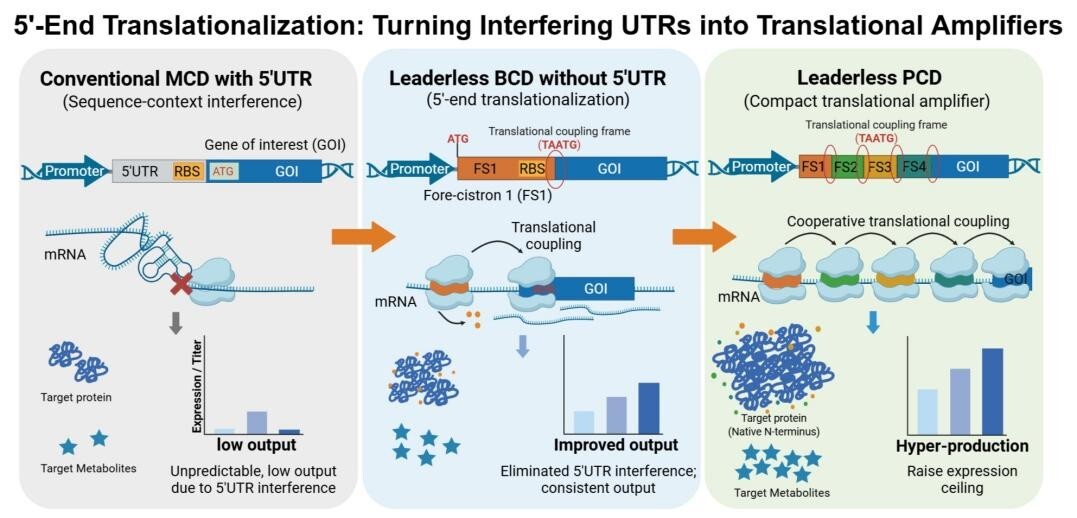
Leaderless polycistronic designs (PCDs) (Image by SUN Manman)
