Researchers from the High Magnetic Field Laboratory of the Hefei Institutes of Physical Science, Chinese Academy of Sciences (CAS), together with collaborators from Ningbo Institute of Materials Technology & Engineering, CAS, and Eastern Institute of Technology, have developed a low-noise magnetic sensor that retains high sensitivity, thereby enabling improved weak-field detection.
The study, published online in Physical Review Letters, reveals a new approach to overcoming the long-standing trade-off between sensitivity and noise in magnetic sensors.
Magnetic sensors with high sensitivity are essential for applications including automotive electronics, industrial inspection, and biomedical imaging. However, efforts to improve sensitivity often lead to increased noise, limiting the ability of sensors to detect extremely weak magnetic signals.
In this study, the research team established a theoretical model that connects magnetic sensor noise with the microscopic dynamics of spin textures—the nanoscale magnetic structures governing sensor behavior. The model shows that low-frequency noise decreases as the characteristic frequency of spin-texture dynamics increases.
Based on this mechanism, the researchers designed a synthetic ferrimagnetic structure with faster spin-texture dynamics to suppress noise. By carefully adjusting magnetic anisotropy near the spin-reorientation regime, they further enhanced sensor sensitivity while reducing noise, breaking the conventional sensitivity–noise limitation.
The resulting anomalous Hall magnetic sensor, with an active sensing area of only 20 μm × 20 μm, achieved a magnetic-field detectivity of 15.7 nT/√Hz at 1 Hz. This performance is nearly one order of magnitude better than that of sensors based on conventional ferromagnetic materials.
The findings provide a new strategy for developing high-performance magnetic sensors, with potential applications in weak biomagnetic signal detection and high-resolution magnetic imaging.
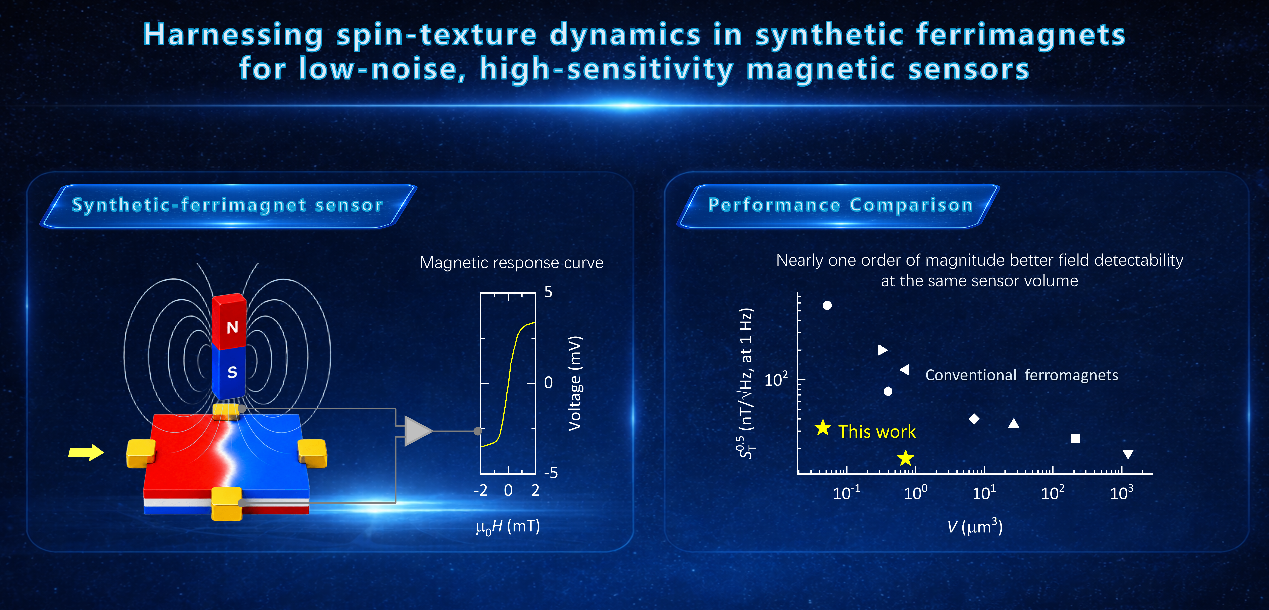
Harnessing spin-texture dynamics in synthetic ferrimagnets for low-noise, high-sensitivity magnetic sensors (Image by WANG Kang)