



Atmospheric aerosols absorb and scatter solar radiation, influencing atmospheric radiative processes and environmental changes. Accurate measurements of these optical properties are therefore essential for understanding aerosol effects on climate and air quality. However, conventional instruments often rely on separate sampling lines and measurement cells, which may introduce particle losses and differences in measurement conditions.
Recently, a research team led by Professor FANG Yonghua at the Hefei Institutes of Physical Science, Chinese Academy of Sciences, developed a dual-differential sphere–tube coupled photoacoustic–scattering system that enables simultaneous measurement of aerosol absorption and scattering at 450 and 532 nm.
The related study was published in Photoacoustics.
The new system adopts a single sampling path and a shared measurement volume, allowing both properties to be obtained from the same aerosol sample. It consists of two high-reflectivity integrating spheres and a central acoustic tube. The integrating spheres collect scattered light while also functioning as acoustic chambers for photoacoustic measurements. By modulating the two wavelengths at different frequencies, the system can separately identify their signals and measure them simultaneously with a digital lock-in amplifier developed by the team.
The two-wavelength measurements allow the system to determine aerosol absorption and scattering coefficients and further calculate important optical parameters, including the absorption Ångström exponent, scattering Ångström exponent, and single-scattering albedo.
The researchers calibrated the absorption and scattering channels using standard reference methods. At 532 nm, the system achieved detection limits of 1.2 Mm-1 for absorption and 1.32 Mm-1 for scattering with a 1-second integration time. Additional tests confirmed that the two acoustic modes could operate independently without significant interference.
The team further evaluated the system using water mist, combustion-generated aerosols and ambient aerosols. The results showed clear separation between scattering and absorption signals. Experiments with cigarette and cotton combustion aerosols revealed different absorption responses at the two wavelengths, while measurements conducted on Hefei Science Island demonstrated the system’s capability for continuous monitoring of aerosol optical properties under real atmospheric conditions.
The newly developed system provides a reliable approach for simultaneous aerosol absorption and scattering measurements, offering potential support for atmospheric research and long-term aerosol monitoring.
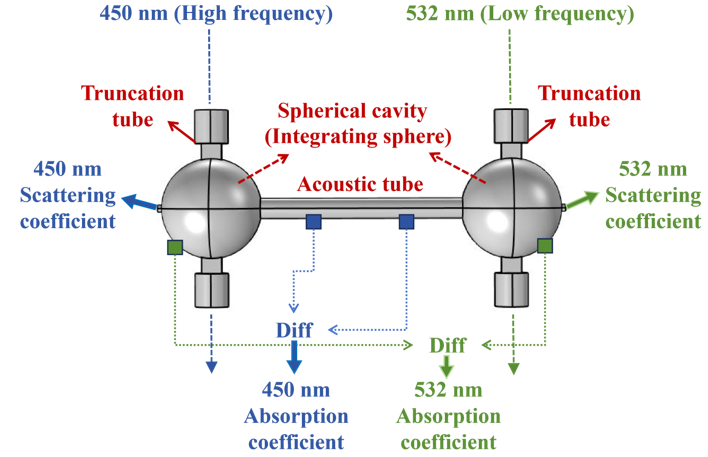
Core structure of the dual-differential sphere–tube coupled photoacoustic–scattering system (Image by LI Zhengang)