Researchers from the Institute of Solid State Physics, Hefei Institutes of Physical Science, Chinese Academy of Sciences, have developed a molybdenum (Mo) alloy that combines high strength, good ductility, and excellent thermal stability at high temperatures.
The study was published in Acta Materialia.
Molybdenum is widely used in aerospace, nuclear energy, and other high-temperature applications due to its high melting point, corrosion resistance, and thermal conductivity. However, conventional dispersion-strengthened Mo alloys often suffer from particle coarsening and segregation during long-term high-temperature service, which weakens their mechanical properties.
In this study, the researchers introduced hafnium diboride (HfB2) into Mo powder and controlled its reaction with residual oxygen during sintering. This process generated high-density nanoscale Hf particles inside Mo grains.
Unlike conventional Mo alloys, where strengthening particles tend to accumulate along grain boundaries, the Hf particles in the Mo–Hf alloy were mainly distributed within the grains. These nanoscale particles effectively hinder dislocation movement and improve the alloy’s deformation resistance.
The Mo–Hf alloy achieved a tensile strength of 754 MPa with good ductility at 400 °C. After long-term annealing at 1000 °C, the alloy retained stable mechanical properties, showing strong resistance to high-temperature degradation.
"During high-temperature processing, hafnium diboride reacts with oxygen impurities in Mo powder to form uniformly distributed nanoscale hafnium particles," said Associate Prof. ZHANG Yange, "Their unique distribution helps strengthen the alloy and maintain its mechanical performance under harsh conditions."
This study provides a practical approach for designing Mo-based materials with a balance of strength, ductility, and thermal stability, supporting their future use in extreme high-temperature environments, according to the team.
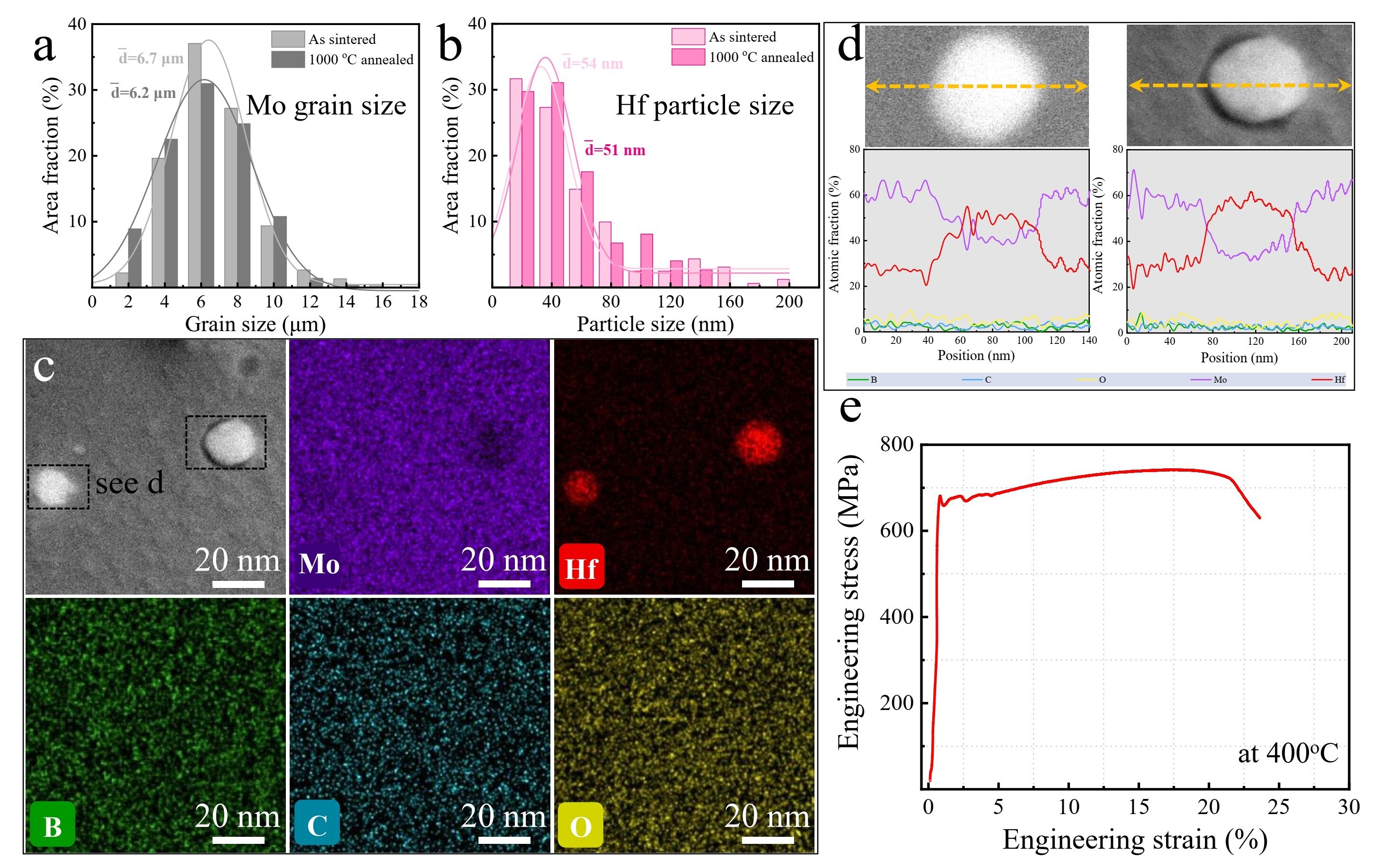
Thermal stability and tensile properties of sintered Mo‑Hf alloys. (Image by ZHANG Yange)