



Researchers from the Hefei Institutes of Physical Science of the Chinese Academy of Sciences have developed a flexible silicone rubber composite that can both contain tritium and shield against nuclear radiation, offering a potential material solution for radiation protection in future fusion facilities.
The research team, led by Dr. HUO Zhipeng, published the findings in the Journal of Materials Research and Technology.
Future fusion facilities need materials that can provide reliable radiation shielding while also maintaining gas tightness and allowing components to be easily removed for maintenance. This is particularly important for areas where pipes and other components pass through radiation shielding structures.
In this study, the researchers developed a silicone rubber composite reinforced with lead tungstate (PbWO4) and boron carbide (B4C). PbWO4 particles with a spindle-like shape were first prepared using a water-based precipitation method. The particles were then combined with B₄C and silicone rubber to make the composite.
The spindle-shaped PbWO4 particles bonded well with the silicone rubber and helped improve the material's stability and mechanical properties. The resulting composite remained stable at high temperatures and showed good resistance to thermal expansion. It also had sufficient strength and flexibility to maintain a gas-tight seal while allowing components to be detached when needed.
The material also showed good resistance to aging. The ability of PbWO4 to absorb ultraviolet radiation helped reduce degradation during accelerated aging tests, with only a small loss in tensile strength.
The researchers further evaluated the material's ability to shield against neutron and gamma radiation through simulations and experiments. The composite provided effective shielding against both types of radiation while helping reduce the production of secondary gamma rays.
"The composite blocked 93.13% of neutrons and 82.76% of gamma rays at a thickness of 15 cm," said Dr. HUO, "It' s shielding performance was comparable to or better than that of concrete used for radiation protection."
The results suggest that the flexible composite could be used in tritium containment and radiation protection systems in future fusion facilities, particularly where sealing, shielding, and ease of maintenance are all required.
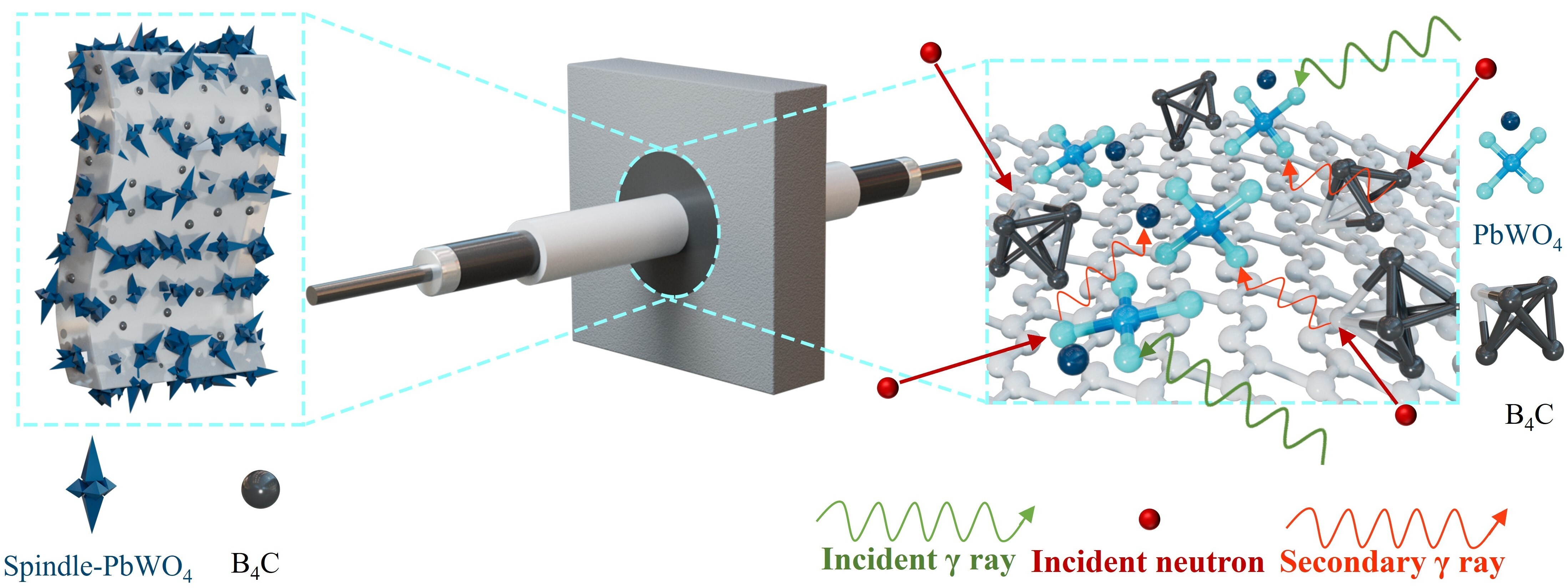
Schematic illustration of the sealing and radiation shielding mechanism of micron spindle-shaped PbWO4 filler-reinforced flexible silicone rubber for penetration holes in nuclear fusion facilities. (HUO Zhipeng)