A research team led by Prof. WANG Zhenyang at the Institute of Solid State Physics, Hefei Institutes of Physical Science, Chinese Academy of Sciences, has developed an electromagnetic wave-absorbing metastructure that can absorb microwaves over a broad frequency range while also supporting loads and removing ice through electrical heating.
The work was published in the Chemical Engineering Journal.
Conventional microwave-absorbing coatings struggle to achieve broadband absorption over a wide range of angles while also serving structural purposes. Multistage metastructures offer more design flexibility, but optimizing their many interacting geometric parameters can be difficult.
The researchers used numerical simulations and machine learning to fine-tune the shape of the three-stage truncated-cone structure. A machine-learning model was then used to select the final design and identify how different parts of the structure affect microwave absorption.
The structure is made from polyamide 6/carbon-fiber composite (PACF), neat polyamide 6 (N-PA), and a laser-treated PACF backing layer. The three stages work at different but overlapping frequency ranges, together covering 2–40 GHz. The layered design helps microwaves enter the structure and dissipate their energy.
"Even with a thickness of just 14.7 mm, the structure maintains strong microwave absorption across a broad frequency range and at large incident angles," said Dr. XI Min, a member of the team, "It still performs well at an incidence angle as high as 75°."
The structure also reduced radar scattering and had sufficient mechanical strength to carry loads. The laser-treated backing layer also enables electrothermal deicing. At 25 V, it reached about 48 °C and melted a 3-mm-thick ice layer within 60 seconds at around 0 °C.
The design could offer a practical option for applications requiring both electromagnetic protection and structural strength, according to the team.
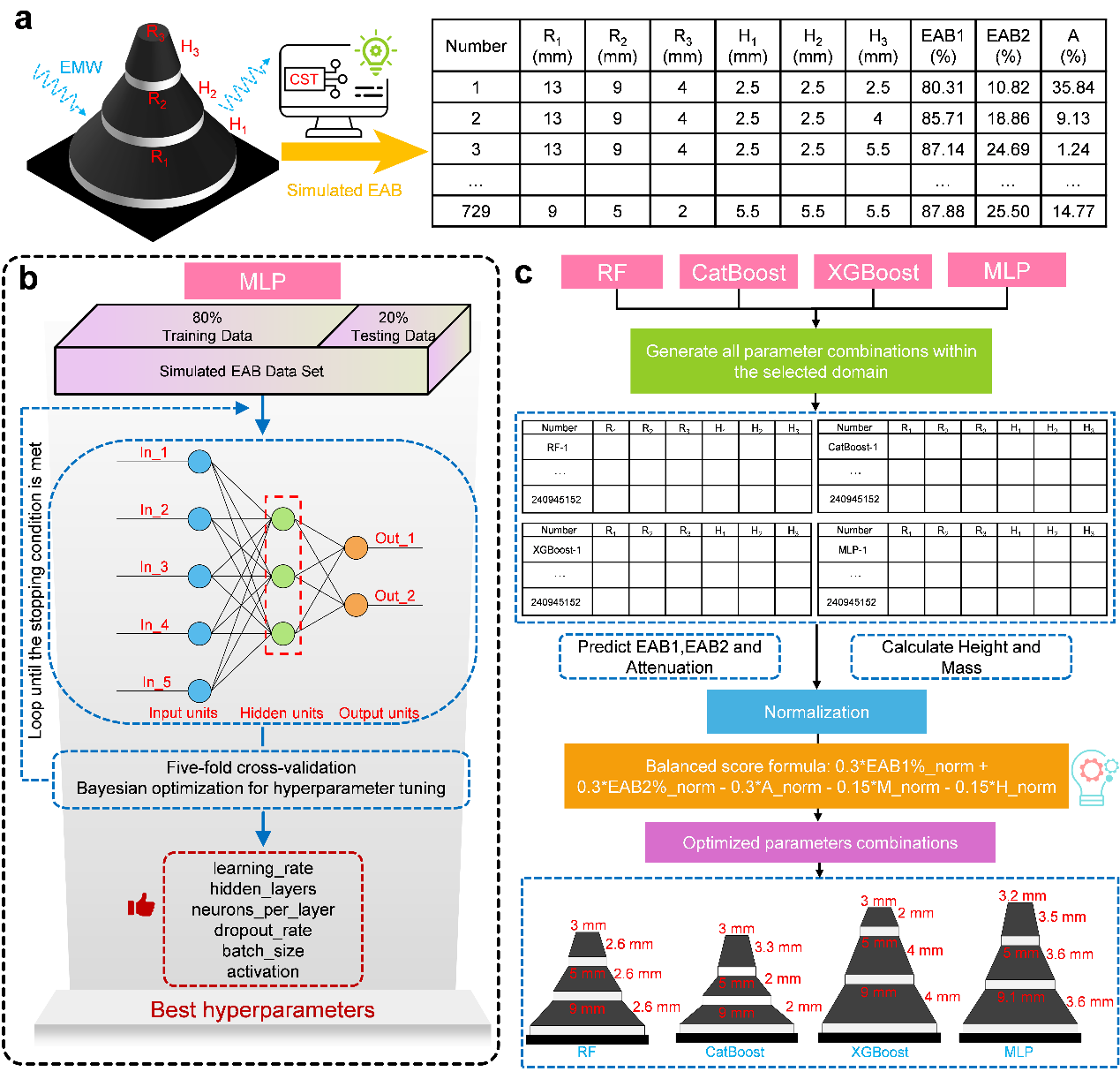
Optimization workflow for the microwave-absorbing structure based on multiple machine-learning surrogate models. (Image by XI Min)